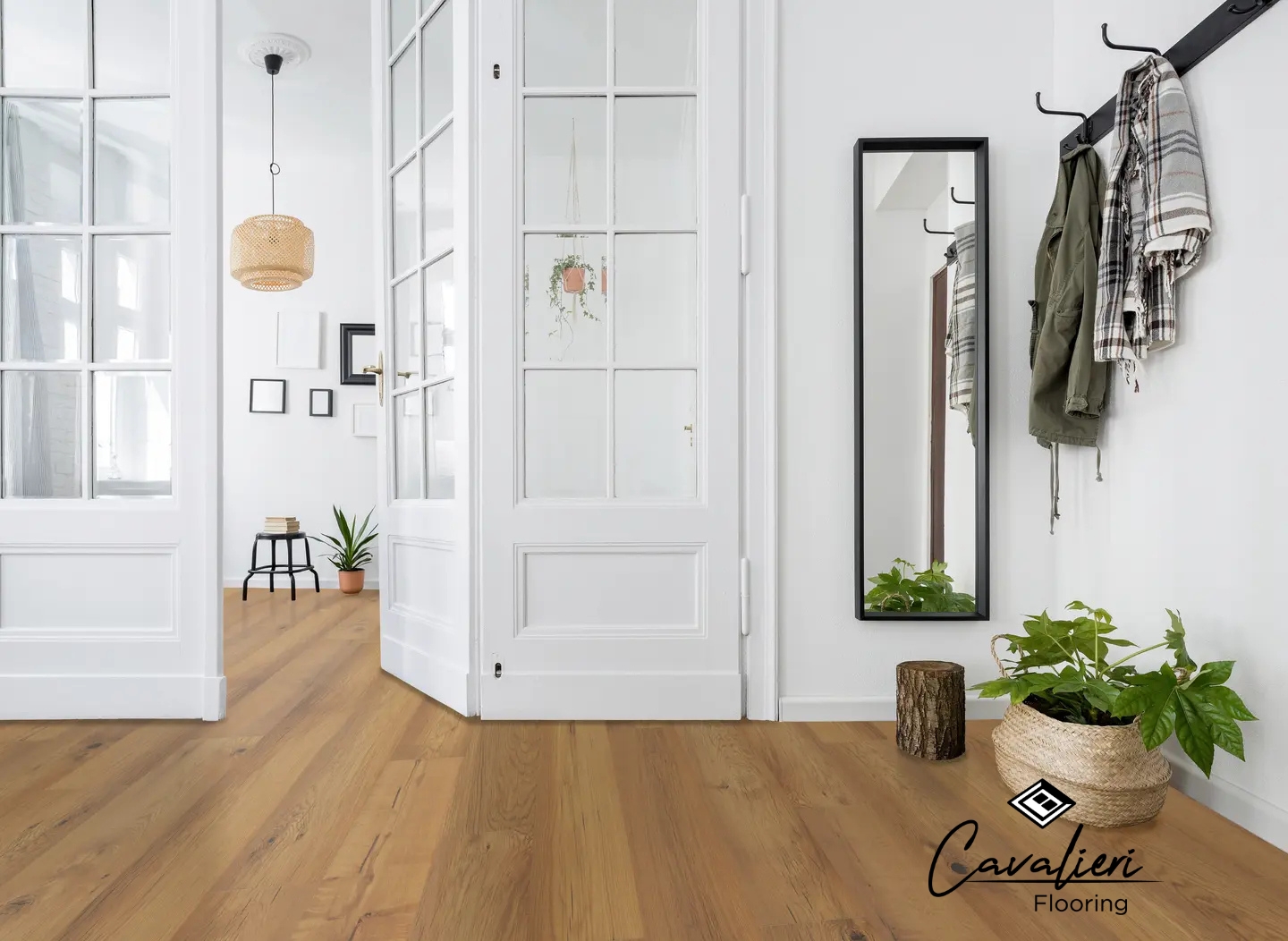
Pre-Installation
Before you begin installation, remember to P.A.C.E. yourself with the checklist below.
P.A.C.E. Pre-Installation Checklist
- Prepare Job Site
- Acclimation
- Control Subfloor Moisture
- Environmental Conditions
Material Allowance
Add 5% extra material for cutting waste and grading allowance. Cavalieri allows up to 5% manufacturing and natural deficiencies per industry standards. Do not install if more than 5% of material is unusable — contact your retailer. No claims accepted for visible defects once installed.
Subfloor Requirements — Wood
Wood subfloors must be securely fastened — nail or screw every 6" along joists to prevent squeaking. Sand high spots and fill low spots with Portland-based leveling compound. Plywood, OSB, or particle board moisture content must be 13% or less. If readings exceed 13%, find and correct the moisture source before installation.
Subfloor Requirements — Concrete
Concrete must be fully cured (minimum 60 days). A moisture barrier is required — use 6-mil plastic, Cavalieri Complete, or Titebond 531+. Cavalieri vinyl is waterproof but NOT a moisture barrier. Test moisture levels before installation. Ensure adequate crawl space ventilation with minimum 18" air space and 6-mil polyethylene sheeting over exposed earth.
Existing Floors
Can be installed over existing tile or vinyl if well-bonded, clean, and level. Fill grout lines and embossing with patch compound. Do not sand existing vinyl (may contain asbestos).
Radiant Heat
Compatible with radiant heat for floating installation only. Turn the system on 3 days before installation. Lower to 65°F 24 hours before installation. Maximum operating temperature: 85°F. Gradually increase temperature after installation; decrease at 1.5°F per day when turning off the system.
Floating Click-Lock Installation (Angle-Angle Method)
Recommended Tools
- Utility knife with fresh blades
- Tape measure and pencil
- Straight edge or T-square
- Rubber mallet
- Tapping block
- Pull bar for tight spaces
- 1/4" spacers
Installation Steps
Step 1: Plan the layout. Measure the room width and divide by plank width to determine the number of rows. If the final row will be less than 1/3 plank width, trim the first row to compensate.
Step 2: Begin along the longest, straightest wall with 1/4" spacers. Trim the tongue from the first row using a utility knife.
Step 3: Connect planks end-to-end using the angle-angle method: lift the plank at a 20° angle, align the short end with the previous plank, and press down to engage both the long and short edge locks simultaneously.
Step 4: Continue the first row, measuring and cutting the final plank. Use the cut piece as the starter for the next row if at least 8" long. Maintain at least 6" offset between end joints.
Step 5: For subsequent rows, angle the long edge of the new plank into the previous row at 20°. Slide the plank along until the short end is aligned, then press down to lock both edges.
Step 6: Use a rubber mallet and tapping block to fully engage all joints. Inspect each plank for gapping before moving on.
Step 7: For the last row, rip planks to the correct width maintaining the expansion gap. Use a pull bar to engage the final row.
Step 8: Remove spacers. Install transition strips at doorways and baseboards or quarter-round to cover expansion gaps.
Care & Maintenance
- Sweep or vacuum regularly using a soft-bristle broom or a vacuum without a beater bar.
- Damp mop with pH-neutral vinyl floor cleaner. Do not use steam mops, abrasive cleaners, or wax.
- Wipe up spills promptly. Use felt pads under furniture and mats under rolling chairs.
- Place doormats at entrances. Maintain temperature 60°F–80°F and humidity 35%–55%.
- Avoid prolonged direct sunlight — use blinds or curtains to reduce UV exposure.
Need Professional Installation?
Our expert installers serve all of Central Florida with up to 2 years warranty coverage.