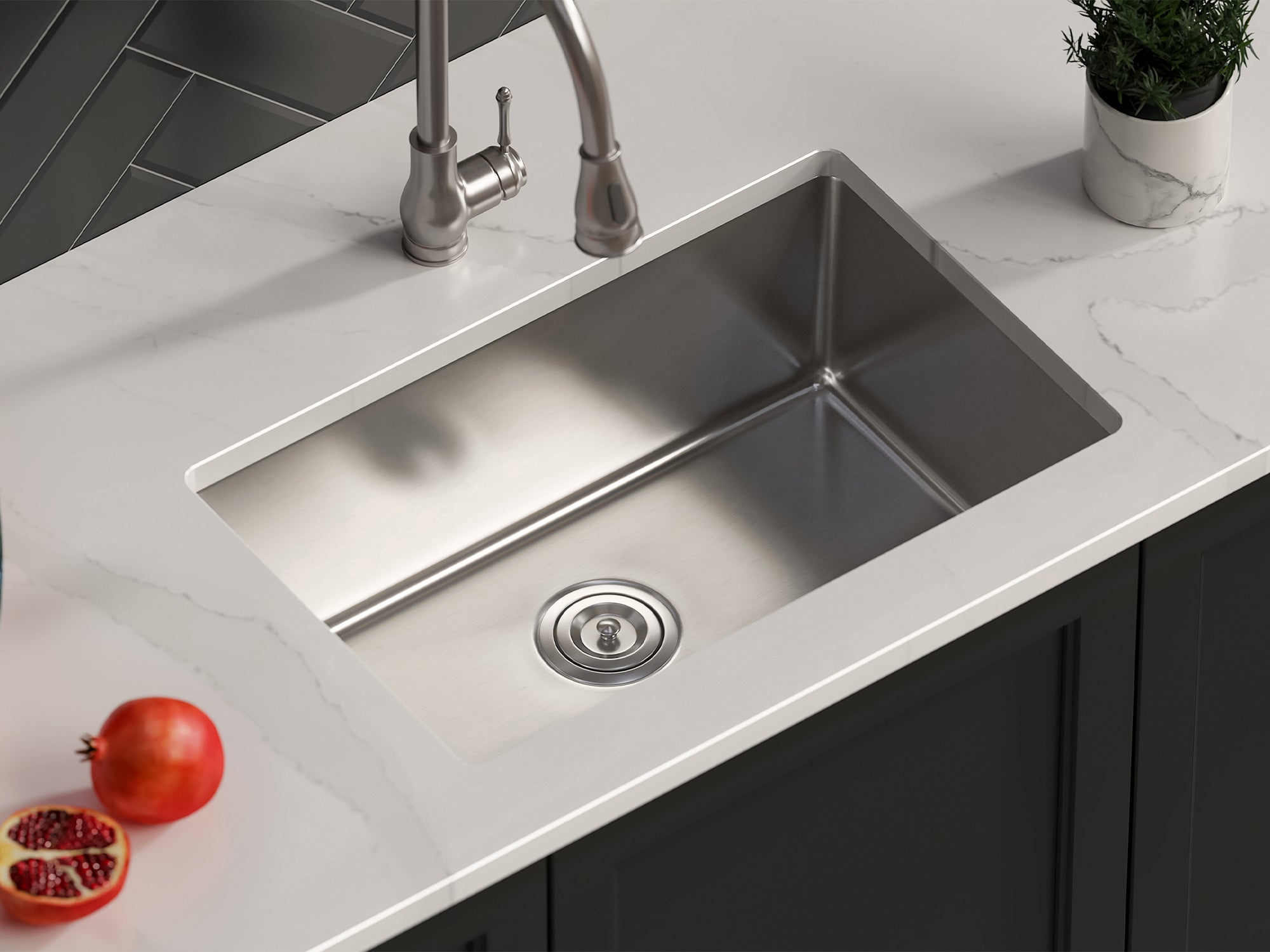
If you are shopping for a new kitchen sink, you may see descriptions such as 304 stainless steel, T-304 stainless steel, 18/8 stainless steel, or 18/10 stainless steel. But what do those numbers mean, and is 304 stainless steel good for kitchen sinks?
Quick Answer: Is 304 Stainless Steel Good for Kitchen Sinks?
Yes. Type 304 stainless steel is one of the best all-around sink materials for normal indoor residential kitchens. It provides a strong balance of corrosion resistance, durability, formability, cleanability, appearance, and cost.
However, the grade is only one part of a sink. Also compare gauge, bowl design, sound-deadening, undercoating, finish, dimensions, mounting style, drain placement, installation requirements, and manufacturing quality.
This guide covers 304 vs. 201 stainless steel sinks, 304 vs. 316 stainless steel sinks, 18/10 stainless steel sinks, and how to identify the best stainless steel grade for a kitchen sink.
What Does 304 Stainless Steel Mean?
The number 304 refers to the alloy grade, not the thickness of the sink. Stainless steel is an iron-based alloy with enough chromium to develop a protective passive surface. Additional alloying elements affect corrosion resistance, strength, formability, and fabrication.
Type 304 is an austenitic stainless steel commonly associated with approximately:
| Element | Typical Type 304 range |
|---|---|
| Chromium | 18–20% |
| Nickel | 8–10.5% |
| Iron | Balance |
| Other elements | Small amounts |
Chromium helps form the thin passive layer responsible for stainless steel's corrosion resistance. Nickel contributes to the structure and fabrication characteristics of austenitic stainless steels. Together, these properties make 304 useful where a surface regularly encounters water, food, cleaning, and everyday handling.
304 Stainless Steel vs. Gauge: What Is the Difference?
When comparing 304 stainless steel kitchen sinks, look at both the alloy grade and gauge rather than judging quality from either specification alone.
These specifications answer different questions:
- 304 describes what the metal is made from.
- 16 gauge or 18 gauge describes how thick the sheet is.
For example, a 16-gauge 304 stainless steel sink combines the Type 304 alloy with thicker sheet construction. An 18-gauge 304 stainless steel sink uses the same general alloy family with slightly thinner construction.
Neither specification replaces the other. A good product description should identify both the stainless steel grade and the gauge. For a full thickness comparison, read our 16-gauge vs. 18-gauge stainless steel sink guide.
Why Is 304 Stainless Steel Popular for Kitchen Sinks?
1. Strong general corrosion resistance
Type 304 performs well in many normal indoor environments. A kitchen sink regularly encounters water, food, moisture, dish soap, wet cookware, and cleaning. It is more accurate to call 304 corrosion-resistant rather than absolutely corrosion-proof.
2. Easy cleaning
Smooth stainless surfaces can be effectively cleaned and maintained hygienically. This is one reason stainless steel is widely used in residential kitchens, commercial kitchens, food-processing equipment, cookware, and appliances.
3. Durable and formable construction
Austenitic stainless steels such as 304 combine useful strength, ductility, and formability. Manufacturers can use them for deep bowls, handmade sinks, drawn sinks, workstation sinks, single bowls, double bowls, farmhouse sinks, and a range of corner shapes.
4. Flexible design compatibility
A brushed or satin stainless finish complements quartz, granite, porcelain, solid-surface countertops, modern kitchens, transitional kitchens, and commercial-inspired designs.
5. Availability across price levels
Because 304 sinks come in different gauges, dimensions, finishes, bowl designs, and manufacturing methods, the words “304 stainless steel” alone do not determine price or overall quality.
304 Stainless Steel vs. 201 Stainless Steel
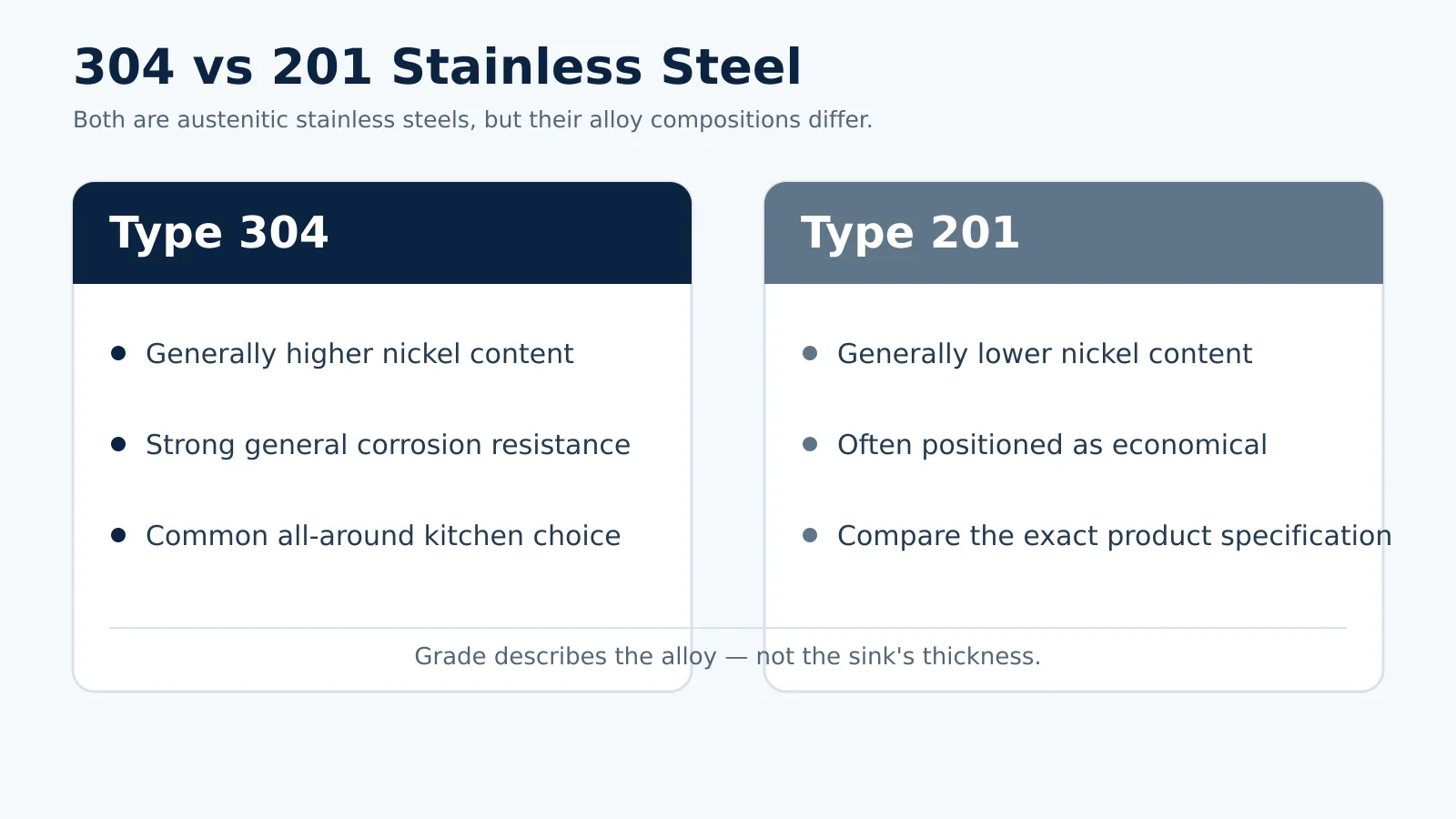
You may encounter less expensive sinks made from 201 stainless steel. Both grades belong to the broader austenitic stainless family, but their compositions differ. Type 201 uses manganese and nitrogen together with lower nickel content than the conventional Type 304 composition.
For a frequently used primary kitchen sink where corrosion resistance and long-term everyday use are priorities, 304 is generally the safer specification. A lower-priced sink made from another alloy is not automatically unusable, but buyers should understand exactly what material they are purchasing.
| Feature | 201 stainless steel | 304 stainless steel |
|---|---|---|
| Stainless family | Austenitic | Austenitic |
| Nickel level | Generally lower | Higher |
| General corrosion resistance | Lower than 304 in many environments | Strong |
| Kitchen sink use | Value applications | Excellent general choice |
| Typical positioning | Lower-cost products | General-purpose and premium products |
304 Stainless Steel vs. 316 Stainless Steel
Type 316 contains molybdenum in addition to chromium and nickel. That addition improves corrosion resistance, particularly in environments involving chlorides such as salt air, marine exposure, pool chemicals, and some outdoor kitchens.
| Feature | 304 stainless steel | 316 stainless steel |
|---|---|---|
| General residential use | Excellent choice | Usually an unnecessary upgrade |
| Chloride resistance | Good | Better |
| Molybdenum | No intentional addition typical of 316 | Approximately 2–3% |
| Indoor Orlando kitchen | Generally appropriate | Usually unnecessary |
| Coastal or aggressive exposure | Requires more care | Worth evaluating |
| Typical cost | Lower | Usually higher |
For most indoor residential kitchens, 304 provides the better balance between required performance and price. A Florida kitchen directly exposed to salt air or an outdoor kitchen deserves a more careful material evaluation; that does not mean every Florida kitchen requires 316.
What Do 18/8 and 18/10 Stainless Steel Mean?
Type 304 is commonly associated with 18/8 stainless steel because its basic composition is around 18% chromium and 8% nickel. The phrase 18/10 stainless steel generally refers approximately to 18% chromium and 10% nickel.
These terms can be useful descriptive information, but they are not a precise substitute for an alloy specification. The actual chemistry of Type 304 falls within defined ranges rather than being exactly 18% chromium and exactly 10% nickel in every product.
Do not confuse 18/10 with 18 gauge: 18/10 refers to approximate alloy composition terminology, while 18 gauge refers to metal thickness.
Can a 304 Stainless Steel Sink Rust?
304 stainless steel is highly corrosion-resistant, but it should not be described as absolutely incapable of rusting or staining. Under unfavorable conditions, localized corrosion or rust-like surface contamination can occur.
Possible causes include chloride-containing chemicals, salt deposits, harsh cleaners, iron contamination, steel wool particles, metal debris, prolonged chemical exposure, and poor maintenance. A small orange mark may come from foreign iron particles deposited on the surface rather than corrosion throughout the stainless steel itself.
Is 304 Stainless Steel Scratch-Proof?
No. Pots, pans, cutlery, sink grids, abrasive pads, and other metal objects can scratch stainless steel during normal use. Scratch visibility is influenced by the finish, grain direction, cleaning technique, and cookware as well as by the alloy.
A satin or brushed finish can help minor everyday scratches blend into the surface appearance. A bottom grid can also keep cookware from constantly contacting the bowl.
What Gauge Is Best for a 304 Stainless Steel Sink?
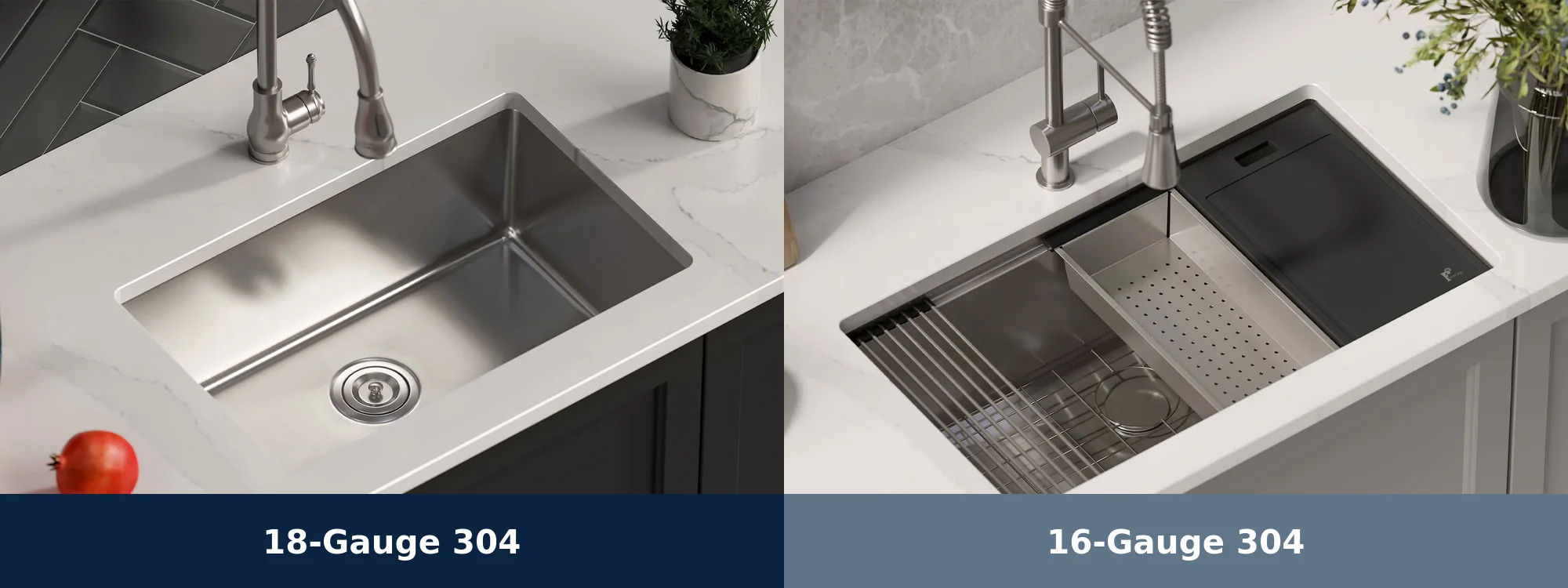
For premium residential kitchen sinks, 16 gauge and 18 gauge are both excellent options.
Consider 16-gauge 304 stainless steel for:
- Large single-bowl sinks
- Workstation sinks
- Heavy cookware
- High-use kitchens
- Premium remodeling
- Buyers who want additional rigidity
Consider 18-gauge 304 stainless steel for:
- Standard residential kitchens
- Condos, apartments, and rental properties
- Smaller or moderately sized bowls
- Buyers wanting strong performance at a lower cost
- Sinks with quality sound-deadening pads and undercoating
Gauge should not be judged separately from the rest of the construction. Our 16 Gauge vs 18 Gauge Stainless Steel Sink guide explains thickness, rigidity, sound control, dent resistance, and value in more detail.
Does a 304 Sink Need Sound-Deadening?
Sound treatment can make a noticeable difference during daily use. Running water, dishes, garbage disposals, and cookware can cause thin metal surfaces to vibrate. Quality sinks may include sound-deadening pads, protective undercoating, rubber or composite insulation, or vibration-damping material.
When comparing sinks, look beyond the words 304 stainless steel and ask how the sink is constructed underneath. Cavalieri Flooring's Pelican PL-VR2718 includes sound-deadening pads and protective coating, while the 16-gauge PL-WS3319 workstation also incorporates underside sound treatment.
Drawn vs. Handmade 304 Stainless Steel Sinks
Drawn sinks
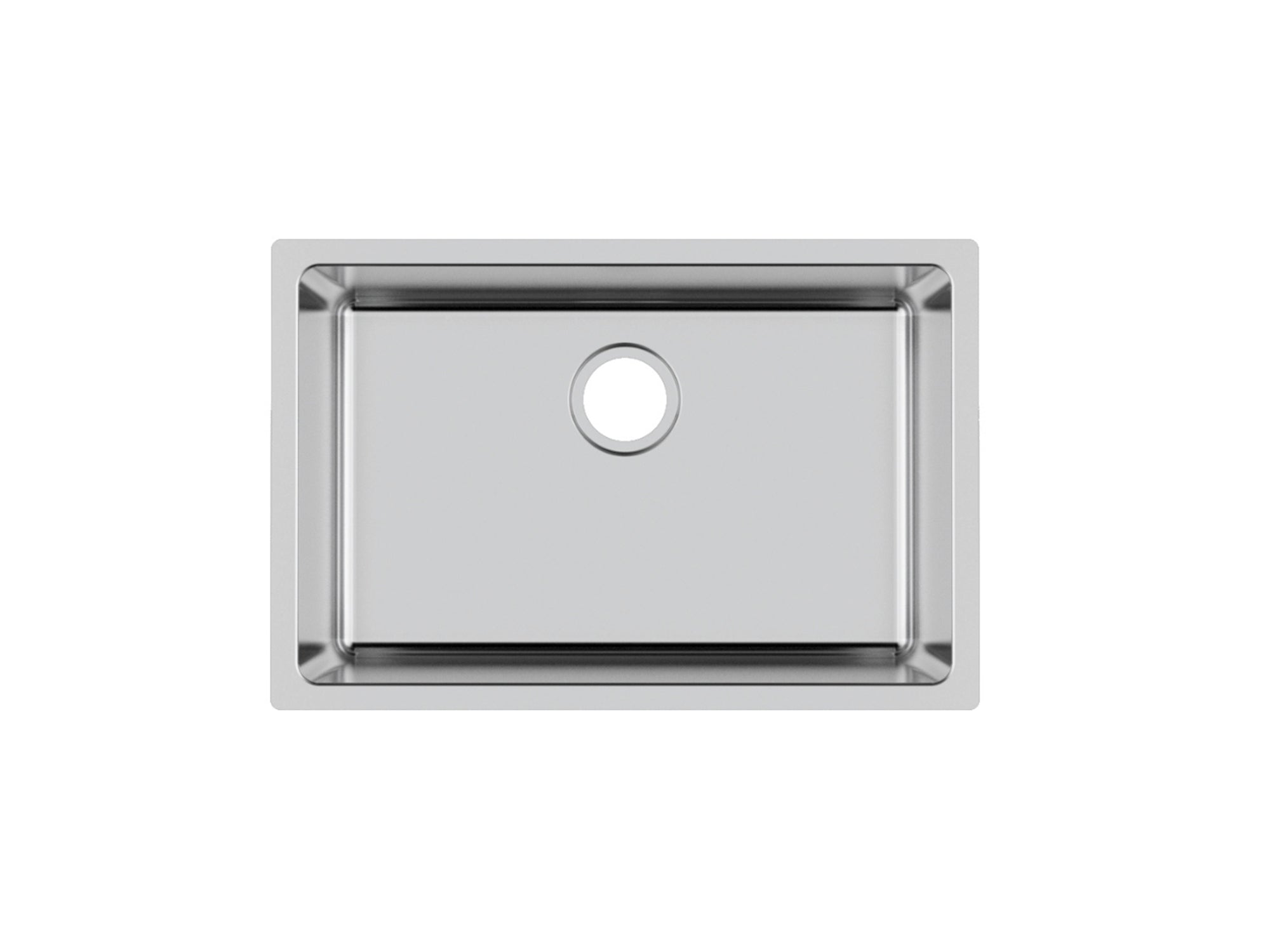
A sheet of stainless steel is formed into the bowl shape. Drawn sinks often offer consistent shapes, rounded or low-radius corners, efficient manufacturing, and good value. The Pelican Urban Series PL-VR2718 is an example of a drawn low-radius sink.
Handmade sinks
Handmade sinks are generally fabricated from pieces of stainless steel rather than formed as a single deep-drawn bowl. They often have straighter walls, tighter corners, deeper bowls, modern geometry, and workstation designs. The Pelican PL-HA115 is a handcrafted 304 stainless steel model with straight-wall construction.
Neither method is automatically superior. Consider style, bowl dimensions, budget, cleaning preference, and desired corner radius.
Is 304 Stainless Steel Good for Undermount, Workstation, and Farmhouse Sinks?
Yes. Type 304 works well for undermount, workstation, and farmhouse sink designs when the specific product is engineered and installed for that application.
- Undermount sinks: Both 16- and 18-gauge 304 sinks can work well. Proper support is especially important with large bowls, heavy garbage disposals, stone countertops, and workstation designs.
- Workstation sinks: A 16-gauge 304 sink can provide a useful combination of corrosion resistance, rigidity, bowl size, and accessory support. The Pelican PL-WS3319 and PL-WS2819 are examples.
- Farmhouse sinks: Evaluate width, bowl depth, cabinet dimensions, sink support, apron design, sound-deadening, finish, grade, and gauge together.
For an apron-front remodel, our farmhouse sink size and model comparison puts those considerations alongside eight real 16-gauge 304 stainless steel options.
How to Tell Whether a 304 Stainless Steel Sink Is High Quality
Instead of judging a sink by one specification, use this checklist:
- Stainless steel grade: Look for Type or Series 304 rather than only “stainless steel.”
- Gauge: Compare quality 16- and 18-gauge products for a primary kitchen sink.
- Sound-deadening: Look underneath the bowl for pads and coating.
- Finish: A brushed or satin finish can be practical for normal kitchen wear.
- Bowl dimensions: Check width, front-to-back measurement, and depth.
- Minimum cabinet requirement: Verify the manufacturer's cabinet dimensions before buying.
- Drain position: Rear or offset drains can affect usable bowl and cabinet space.
- Corner radius: Choose between tight modern geometry and easier-to-clean rounded corners.
- Included accessories: Check for bottom grids, strainers, cutting boards, colanders, and drying racks.
- Documentation: Look for specifications, installation templates, care instructions, and warranty information.
How to Clean and Maintain a 304 Stainless Steel Sink
The sink manufacturer's care instructions should always take priority. For routine maintenance:
- Rinse food and residue from the bowl.
- Wash with mild dish soap and water.
- Use a soft cloth or nonabrasive sponge.
- Rinse thoroughly.
- Dry the surface when practical to reduce mineral spotting.
Avoid leaving aggressive chemicals or chloride-containing cleaners on the surface. Do not use ordinary steel wool or carbon-steel brushes because particles can contaminate stainless steel. Clean a brushed finish in the direction of the grain.
To reduce water spots, rinse after heavy use, wipe standing water away, and dry with a soft microfiber cloth. Water spotting is primarily a maintenance and water-quality issue, not proof that the sink is poor-quality stainless steel.
Can a Magnet Test Whether a Sink Is 304?
Not reliably. Type 304 is generally nonmagnetic in its annealed state, but forming and cold working during manufacturing can alter magnetic response in portions of a finished sink. Use manufacturer specifications, product documentation, reputable sellers, and material certifications when required rather than relying on a refrigerator magnet alone.
Frequently Asked Questions About 304 Stainless Steel Sinks
Is 304 stainless steel good for kitchen sinks?
Yes. Type 304 combines corrosion resistance, durability, formability, cleanability, and cost, making it an excellent all-around material for indoor residential kitchen sinks.
What does 304 mean on a kitchen sink?
304 identifies the stainless steel alloy grade. It does not describe thickness. Gauge describes thickness.
Is 304 stainless steel better than regular stainless steel?
“Stainless steel” describes an entire family of alloys. Identifying Type 304 gives the buyer more useful material information than an unspecified stainless label.
Is 304 stainless steel rust-proof?
No. Type 304 offers strong general corrosion resistance, but chloride exposure, aggressive chemicals, contamination, and environmental conditions can still produce staining or localized corrosion.
Which is better, 304 or 316 stainless steel?
For most indoor residential kitchen sinks, 304 provides excellent performance and value. Type 316 is more attractive for some coastal, marine, poolside, or aggressive outdoor conditions.
Which is better, 201 or 304 stainless steel?
For a primary kitchen sink where corrosion resistance is a priority, 304 is generally the stronger all-around specification.
Is 18/10 the same as 18 gauge?
No. 18/10 refers to approximate chromium-and-nickel composition terminology; 18 gauge refers to metal thickness.
Which is better: 16-gauge 304 or 18-gauge 304?
Both can be excellent. Choose 16 gauge for additional rigidity in large or heavily used sinks; choose a well-constructed 18-gauge sink for strong everyday performance and value.
Is 304 stainless steel good for outdoor kitchens?
It can suit many protected or inland outdoor applications, but highly corrosive salt or chloride environments may justify considering Type 316.
Sources & References
- Specialty Steel Industry of North America — Technical Resources for Type 304 and 316 composition, passive-film context, chloride resistance, and gauge conventions.
- Nickel Institute for the use and cleanability of nickel-containing austenitic stainless steels in food-contact environments.
Shop 304 Stainless Steel Kitchen Sinks
Cavalieri Flooring carries Pelican stainless steel sinks in several configurations, including 304 stainless steel, 16-gauge and 18-gauge models, undermount sinks, handmade sinks, workstation sinks, farmhouse sinks, and single- or double-bowl designs.
Examples include the 18-gauge 304 Series Pelican Urban PL-VR2718 and the 16-gauge 304 Series Pelican PL-WS3319 workstation sink.