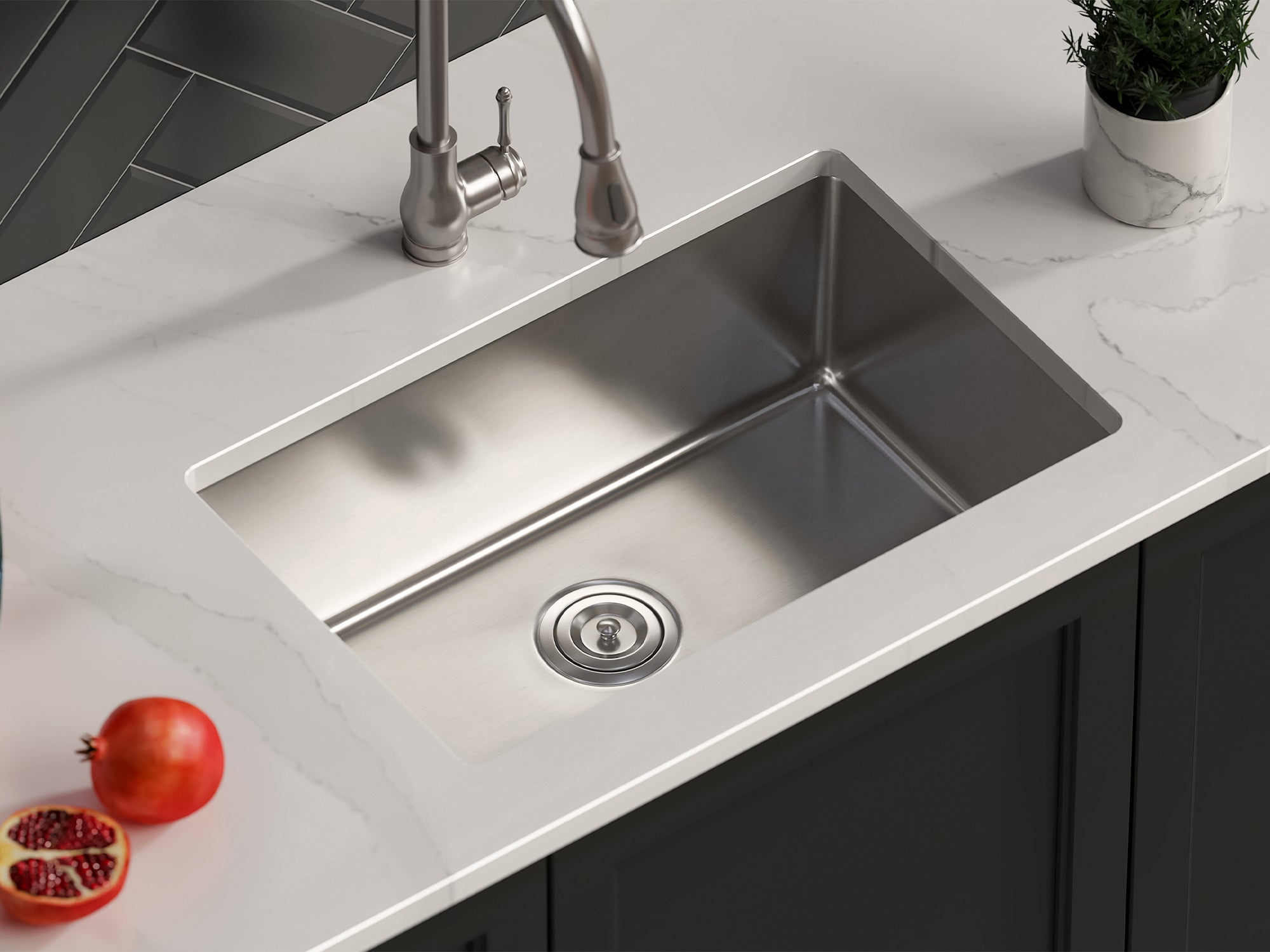
Quick answer: Choose an undermount sink when you want a clean countertop-to-bowl transition, easy countertop cleanup, and you have a countertop material and installation method that support it. Choose a drop-in sink when easier installation, simpler replacement, broader countertop compatibility, or a lower-complexity remodel matters more. Neither mounting style is automatically better—the right choice depends first on the countertop, then on budget, maintenance, sink size, and how permanent the renovation is.
When homeowners compare kitchen sinks, they often focus first on stainless steel gauge, bowl size, or whether the sink is single- or double-bowl. But one of the most important decisions happens before those details: how will the sink mount to the countertop?
An undermount sink attaches below the countertop. A drop-in sink—also called a top-mount or self-rimming sink—rests in the countertop opening from above. The difference changes the finished appearance, how you wipe down the counter, what countertop materials are practical, how the opening must be fabricated, and how easy the sink may be to replace later.
Undermount vs. Drop-In Kitchen Sink: Quick Comparison
| Feature | Undermount Sink | Drop-In / Top-Mount Sink |
|---|---|---|
| Installation position | Attached below countertop | Rim rests on top of countertop |
| Look | Seamless, modern, counter-forward | Visible rim, traditional or utilitarian |
| Counter cleanup | Easy to wipe crumbs directly into bowl | Raised rim interrupts the wipe path |
| Countertop compatibility | Best where the exposed cut edge can be finished and supported correctly | Broad compatibility, including many laminate applications |
| Fabrication | More precise; exposed cutout must look finished | Rim covers the cutout edge |
| Replacement | Can be more constrained by existing cutout/reveal | Often easier if a compatible replacement fits the opening |
| Best fit | Stone/quartz remodels, premium kitchens, easy counter cleanup | Budget remodels, laminate counters, faster replacements, simple retrofits |
Start with the countertop—not the sink style.
If the countertop cannot safely support and expose an undermount cut edge, the decision may already be made. Always verify the countertop fabricator's and sink manufacturer's installation requirements before ordering.
What Is an Undermount Kitchen Sink?
An undermount sink is secured to the underside of the countertop so the sink rim is hidden below the work surface. From above, you primarily see the countertop edge and the bowl opening rather than a stainless rim sitting on top of the counter.
This style is popular with quartz, granite, stone, concrete, and compatible solid-surface countertops because the exposed sink cutout can be finished cleanly. BLANCO describes undermount sinks as clamped to the bottom of the countertop and notes that the exposed edge must be carefully finished rather than left as a rough cut.
Advantages of an undermount sink
- Easy countertop cleanup: crumbs and water can be wiped directly from the counter into the bowl.
- Clean appearance: there is no raised metal rim interrupting the countertop.
- Shows off the countertop: useful when quartz, granite, or stone is a major design feature.
- More uninterrupted work surface: the rim does not occupy visible counter space around the opening.
- Excellent fit for modern stainless-steel sinks: single-bowl, double-bowl, handmade, and workstation designs are widely offered as undermount products.
Disadvantages of an undermount sink
- Installation and countertop fabrication are usually more demanding.
- The countertop edge around the cutout remains visible and must be finished appropriately.
- The sink needs proper mechanical support and sealing beneath the counter.
- Replacing it later can be more complicated if the new sink does not match the existing cutout.
- The joint where sink and counter meet underneath still needs to be kept clean and properly sealed.
What Is a Drop-In or Top-Mount Sink?
A drop-in sink is lowered into a countertop cutout from above. A visible rim around the sink rests on top of the counter and helps support the sink. Mounting clips and sealant are then used according to the sink's installation instructions.
Drop-in sinks are also called top-mount or self-rimming sinks. Because the rim covers the raw edge of the countertop cutout, this style works in situations where an exposed sink edge would not be suitable.
Advantages of a drop-in sink
- Broad countertop compatibility: including many laminate and other water-sensitive-core countertops where a standard exposed undermount edge is not practical.
- Simpler installation: the rim rests on the counter rather than suspending the bowl entirely below it.
- Easier replacement path: especially if a new sink matches the existing opening.
- Cutout edge is hidden: less cosmetic finishing is required around the hole.
- Practical for budget renovations: especially when the countertop is staying in place.
Disadvantages of a drop-in sink
- The visible rim interrupts the countertop surface.
- Crumbs, water, and residue can collect around the rim and sealant line if it is not cleaned regularly.
- It usually creates a more traditional appearance than an undermount installation.
- The rim takes up a small amount of usable countertop area around the bowl.
Which Sink Works With Quartz, Granite, Laminate, and Other Countertops?
Countertop compatibility is the single most important decision factor. An undermount installation exposes the cut edge of the counter. That edge must be structurally appropriate, finishable, and able to support the mounting system specified for the sink.
Quartz and granite
Quartz and granite are common undermount pairings because fabricators can create and finish the sink opening. Drop-in sinks also work, but many homeowners choose undermount specifically to preserve a continuous stone surface.
Solid-surface countertops
Many solid-surface systems can accept undermount sinks, but the correct attachment method depends on the countertop and sink manufacturer. Verify the exact system rather than assuming every solid-surface product is installed the same way.
Laminate
For standard laminate countertops with a water-sensitive core, a conventional drop-in sink is often the safer and simpler choice because its rim covers and protects the cutout edge. Specialized undermount systems can exist, but do not assume a normal undermount sink can simply be attached to standard laminate.
Tile, butcher block, and specialty surfaces
These require project-specific planning. A drop-in sink can simplify the edge condition, while an undermount may demand special fabrication or waterproofing details. Follow the countertop manufacturer's instructions and coordinate the sink before the opening is cut.
Which Is Easier to Clean?
For countertop cleanup, undermount usually wins. With no raised rim on top of the counter, you can wipe crumbs, coffee grounds, water, and food scraps directly into the sink. BLANCO specifically highlights this as a major reason homeowners choose undermount sinks.
A drop-in sink has a visible rim. That rim is not difficult to clean, but it creates another edge where water and debris can collect. The sealant line should be kept clean and inspected so water does not work underneath it.
Undermount is not maintenance-free, however. The underside seam between the sink flange and countertop still needs a sound seal. Depending on the reveal style, there may also be a narrow ledge where residue can collect.
Installation and Replacement: Which Is Easier?
A drop-in sink generally provides the simpler installation and replacement path. The sink is lowered into the opening, sealed, clipped, and connected. KOHLER's current kitchen-sink installation guide distinguishes the two methods: top-mount sinks are set into the opening from above, while undermount sinks use sealant and mounting brackets beneath the countertop.
An undermount installation usually needs more coordination among the sink, countertop fabricator, mounting hardware, and plumbing. The opening must be accurate because it remains visible. The sink also needs correct support for its own weight plus water, cookware, accessories, and—when present—a garbage disposal.
Replacing an existing sink
If you are keeping the old countertop, replacement dimensions can matter more than the mounting style itself. A new drop-in sink with a rim large enough to cover the existing opening may be relatively straightforward. An undermount replacement can be more restrictive because the visible cutout and reveal were fabricated around the previous sink.
Before ordering any replacement, compare the manufacturer's cutout/template, overall sink dimensions, bowl dimensions, corner radii, drain position, faucet location, and minimum cabinet requirement.
Which Usually Costs More: Undermount or Drop-In?
There is no universal price because sink material, size, gauge, accessories, countertop work, plumbing, and local labor all matter. But undermount installations usually involve more fabrication and installation complexity than comparable drop-in installations.
The sink itself may not always cost more. The difference often comes from the finished countertop cutout, mounting method, support, and labor. If you are already installing new quartz or granite, the incremental difference may feel smaller than it would in a simple sink-only replacement.
For a budget-focused remodel where the existing countertop is staying, a drop-in sink can be the more economical path because it may avoid more involved countertop fabrication.
Positive, Zero, and Negative Reveal: The Undermount Detail Buyers Miss
With an undermount sink, the countertop can meet the sink in different ways. The chosen reveal changes the finished look and can affect cleaning.
- Positive reveal: a small portion of the sink rim is visible inside the opening.
- Zero reveal: countertop and sink edge align closely.
- Negative reveal: the countertop slightly overhangs the sink edge.
BLANCO notes all three as common undermount options. There is not one universally correct reveal. The best choice depends on the sink template, fabricator, desired appearance, cleaning preference, and manufacturer instructions.
Mounting Style Is Only One Part of Stainless Steel Sink Quality
Once you know whether undermount or drop-in fits the project, compare the sink itself. A mounting method cannot compensate for a poorly matched bowl, weak construction, insufficient sound treatment, or the wrong dimensions.
For stainless steel sinks, check:
- Steel grade: Type 304 is widely used for quality kitchen sinks.
- Gauge: 16 gauge is thicker than 18 gauge, but both can be appropriate depending on the sink and application.
- Sound treatment: pads and undercoating can reduce vibration and noise.
- Bowl depth and corner radius: these affect usable space and everyday cleaning.
- Drain position: it can affect cabinet space and how dishes sit in the bowl.
- Accessories: grids, strainers, cutting boards, colanders, and drying racks can change total value.
- Warranty and installation instructions: verify the exact model rather than buying from marketing language alone.
For a deeper comparison, read our guides to 16 gauge vs. 18 gauge stainless steel sinks and 304 stainless steel kitchen sinks.
Undermount vs. Drop-In for Workstation and Large Kitchen Sinks
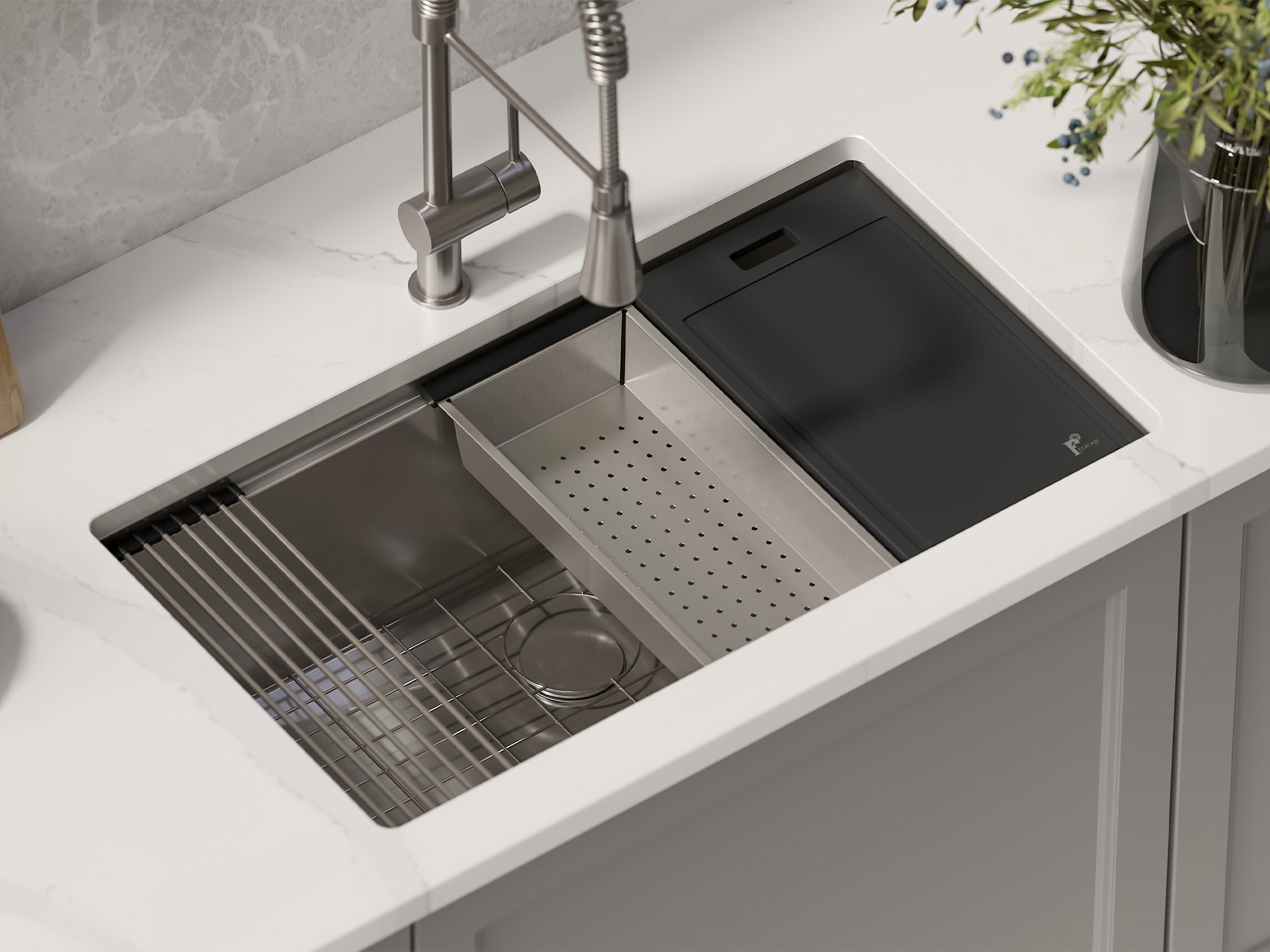
Workstation sinks use an integrated ledge that supports accessories such as cutting boards, colanders, drying racks, and grids. Because they are often wide, deep, and used for active prep, the installation should be planned as a system rather than treating the sink as a simple bowl.
Cavalieri Flooring's Pelican PL-WS3319, for example, is a 33" × 19" × 10" workstation built from 16-gauge 304 Series stainless steel and includes a bottom grid, cutting board, colander, folding rack, basket strainer, and drain cover.
For a large undermount or workstation sink, verify:
- minimum base-cabinet size;
- countertop support and mounting hardware;
- garbage-disposal weight and clearance;
- drain and P-trap position;
- faucet reach across the usable bowl;
- clearance for workstation accessories;
- countertop reveal and finished edge.
If you are pairing a sink and faucet, also use our kitchen faucet buying guide and pull-down vs. pull-out faucet comparison.
What to Measure Before Ordering a New Kitchen Sink
A beautiful sink that does not fit the cabinet or countertop is the wrong sink. Before ordering either mounting style, measure the entire installation—not only the advertised sink width.
- Sink base cabinet width. Check the manufacturer's minimum cabinet requirement.
- Existing countertop cutout. Critical for replacement projects.
- Sink overall width and front-to-back depth. Confirm countertop margins around the opening.
- Bowl depth. Deeper sinks consume more cabinet space underneath.
- Drain location. Rear and offset drains can change plumbing and storage space.
- Faucet deck / countertop space. Leave enough room for the faucet, soap dispenser, air switch, filtered-water faucet, or other accessories.
- Backsplash and window clearance. Especially important when using a tall pull-down faucet.
- Garbage disposal and plumbing clearance. Verify the combined depth before the countertop is cut.
Replacing the Sink Without Replacing the Countertop?
If the countertop is staying, do not order from the sink's outside width alone. The existing opening, corner shape, rim coverage, faucet holes, and cabinet clearance may determine which models can actually fit.
Undermount vs. Drop-In for Florida Kitchens
Florida humidity does not automatically make one mounting style better. The more important issue is water management at the sink-to-counter connection, especially around materials that can swell or deteriorate if their core remains wet.
Keep the sealant maintained, repair leaks quickly, and do not allow recurring water intrusion around the cutout. In a stone or quartz remodel, undermount can provide the clean look and countertop wipe-down many homeowners want. In a rental, budget renovation, or laminate-counter replacement, drop-in may be the more practical serviceable choice.
Also think about replacement strategy. A rental or investment property may benefit from a sink that is easy to service later, while an owner-occupied kitchen with new stone counters may prioritize a seamless undermount appearance.
Which Should You Choose?
Choose an undermount sink if:
- you are installing new quartz, granite, stone, concrete, or another compatible solid surface;
- you want a modern, seamless countertop line;
- you frequently wipe food and water directly from the counter into the sink;
- you are comfortable with more precise fabrication and installation;
- you have already selected the sink before the countertop opening is fabricated.
Choose a drop-in sink if:
- you are keeping an existing countertop and want a simpler replacement;
- you have a laminate countertop or another surface better suited to a covered cut edge;
- installation simplicity and serviceability matter more than a seamless look;
- you want the sink rim to cover the countertop cutout;
- you are working within a tighter remodeling budget.
The deciding question is not “Which sink looks better?” It is: Which mounting method fits this countertop, this cutout, this cabinet, and the way this kitchen will be used?
Shop Stainless Steel Kitchen Sinks
Cavalieri Flooring carries stainless steel kitchen sinks in multiple sizes and constructions. If you are planning an undermount installation, start by comparing the exact model dimensions, cabinet requirements, bowl depth, gauge, sound treatment, and installation resources before the countertop is fabricated.
Featured Undermount Sink Options
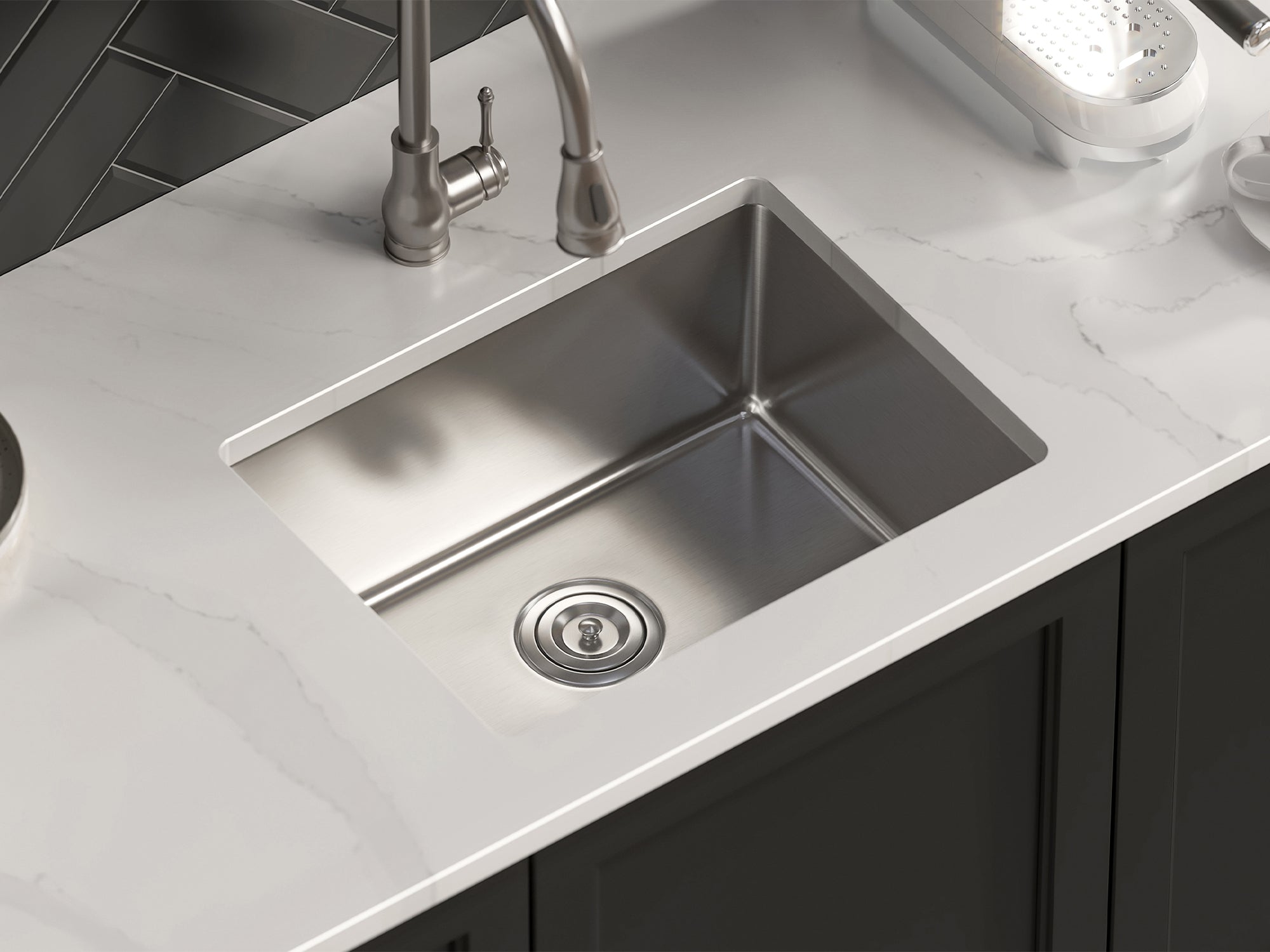
- Pelican PL-VR2318 — 23" × 18" × 9", 18-gauge 304 stainless steel; compact option for smaller kitchens and prep areas.
- Pelican PL-VR2718 — 27" × 18" × 9", 18-gauge 304 stainless steel with sound-deadening pads and protective coating.
- Pelican PL-WS3319 Workstation — 33" × 19" × 10", 16-gauge 304 stainless steel with integrated workstation accessories.
Frequently Asked Questions
Is an undermount sink better than a drop-in sink?
Not automatically. Undermount is often preferred with compatible stone or solid-surface countertops because it creates a clean look and makes countertop cleanup easier. Drop-in is often better when you want broad countertop compatibility, easier installation, simpler replacement, or a more budget-focused remodel.
Can you install an undermount sink with laminate countertops?
Do not assume a standard undermount sink can be installed in ordinary laminate. The exposed sink cutout can expose a water-sensitive core. Specialized systems may exist, but the countertop manufacturer, fabricator, and sink instructions should all support the installation. A conventional drop-in sink is commonly used with laminate because the rim covers the cut edge.
Is an undermount sink harder to clean?
The countertop is usually easier to clean because there is no raised rim. However, the sink-to-counter seam underneath the countertop still needs to remain clean and properly sealed. Reveal style can also affect how easy the junction is to wipe.
Can I replace an undermount sink without replacing the countertop?
Sometimes, but replacement can be restrictive. The new sink must work with the existing countertop opening, corner radius, reveal, cabinet space, mounting system, and plumbing. Measure and compare the actual cutout/template before ordering.
Can a drop-in sink be installed in quartz or granite?
Yes, when the sink and countertop are properly fabricated and installed. Quartz or granite does not force you to use undermount. Many homeowners simply choose undermount with stone because they prefer the cleaner countertop transition.
Which sink is better for a rental property?
It depends on the countertop and maintenance plan. A drop-in sink can be attractive when serviceability and replacement simplicity are priorities. An undermount sink can still be a good rental choice with compatible counters and proper installation, especially when appearance and easy counter cleanup matter.
Does sink gauge determine whether it can be undermounted?
No. Gauge describes stainless-steel thickness, not the mounting method. A sink must be specifically designed and installed for the intended mounting style. Compare the exact product instructions, gauge, size, support, and countertop requirements together.
Is a workstation sink better as an undermount?
Many workstation sinks use undermount installation because it creates a clean transition around the ledge system, but the correct mounting method is model-specific. Follow the exact workstation sink template and installation instructions.
Need Help Choosing the Right Kitchen Sink?
Tell us your cabinet size, countertop material, existing cutout, preferred bowl layout, and whether you are considering an undermount or workstation sink. We can help you narrow down compatible options and plan the installation before you order.
Or call: (321) 424-0546
Related Sink Guides & Shopping Links
Sources & References
Ready to Compare Kitchen Sinks?
Start with the countertop and cabinet dimensions, then compare bowl size, mounting style, 304 stainless steel, gauge, sound treatment, and accessories. Cavalieri Flooring ships sink products nationwide and can help you compare compatible options before you order.