Quick answer: A workstation sink is worth it when you regularly prep food at the sink, need more usable counter space, want fitted cutting-board/colander/drying accessories, or like one large single bowl that can create temporary work zones. It may not be worth the extra complexity if you rarely cook, already have a large island, want the simplest sink to clean and replace, or know the accessories will spend most of their time in a cabinet. The ledge is useful only when it matches the way you actually use the kitchen.
Workstation sinks are one of the most visible kitchen-sink upgrades right now. Instead of using the sink only for washing and rinsing, a workstation adds one or more integrated ledges that support fitted accessories over the bowl. A cutting board can become extra prep space. A colander can sit directly over the drain. A folding rack can create a drying zone without taking over the countertop.
That sounds convenient—and in the right kitchen it is. But the workstation label can also make an ordinary sink sound automatically more advanced than it really is. The better question is not, “Is a workstation sink trendy?” It is: Will the ledge and accessories remove friction from the way you cook, prep, wash, and clean?
This guide compares workstation sinks with regular kitchen sinks, explains the real pros and cons, shows where the accessories help and where they become clutter, and walks through the measurements and installation details you should verify before ordering.
Workstation Sink vs. Regular Sink: Quick Comparison
| Feature | Workstation Sink | Regular Sink |
|---|---|---|
| Integrated ledge | Yes | Usually no |
| Prep space | Can create temporary work surface over bowl | Prep generally happens on surrounding counter |
| Accessories | Model-specific boards, colanders, racks, grids | Universal accessories may be easier to substitute |
| Open-bowl access | Reduced while accessories are installed | Usually fully open |
| Cleaning | Extra ledges/accessories to wipe and store | Typically simpler |
| Best for | Frequent prep, compact counters, organized sink workflow | Simple washing, low maintenance, easy replacement |
| Buying priority | Accessory ecosystem + dimensions + construction | Bowl dimensions + construction + mounting style |
Already leaning toward a workstation?
Compare Cavalieri Flooring's workstation sink collection, then verify the exact cabinet, cutout, faucet, plumbing, and accessory requirements before ordering.
What Is a Workstation Kitchen Sink?
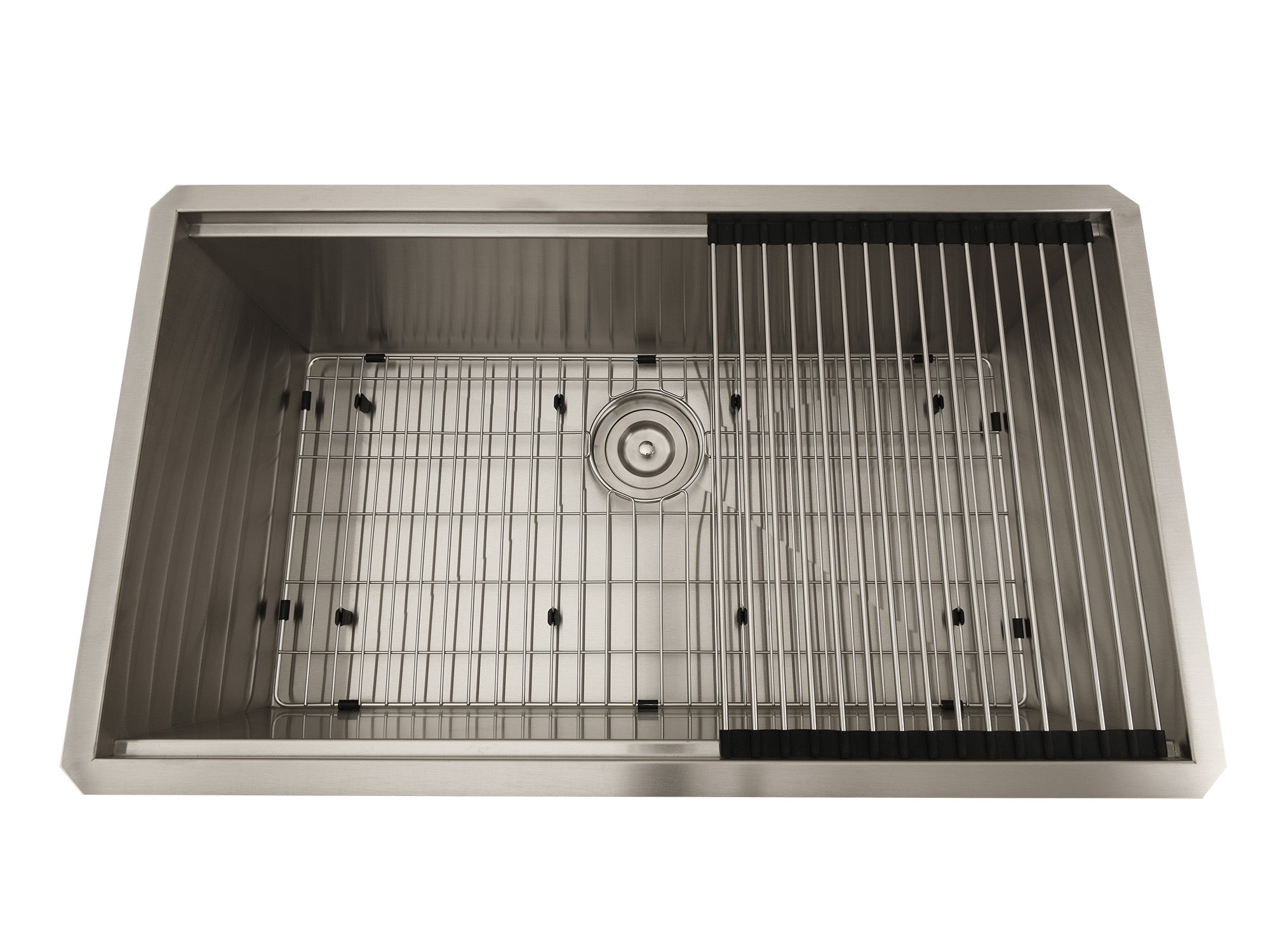
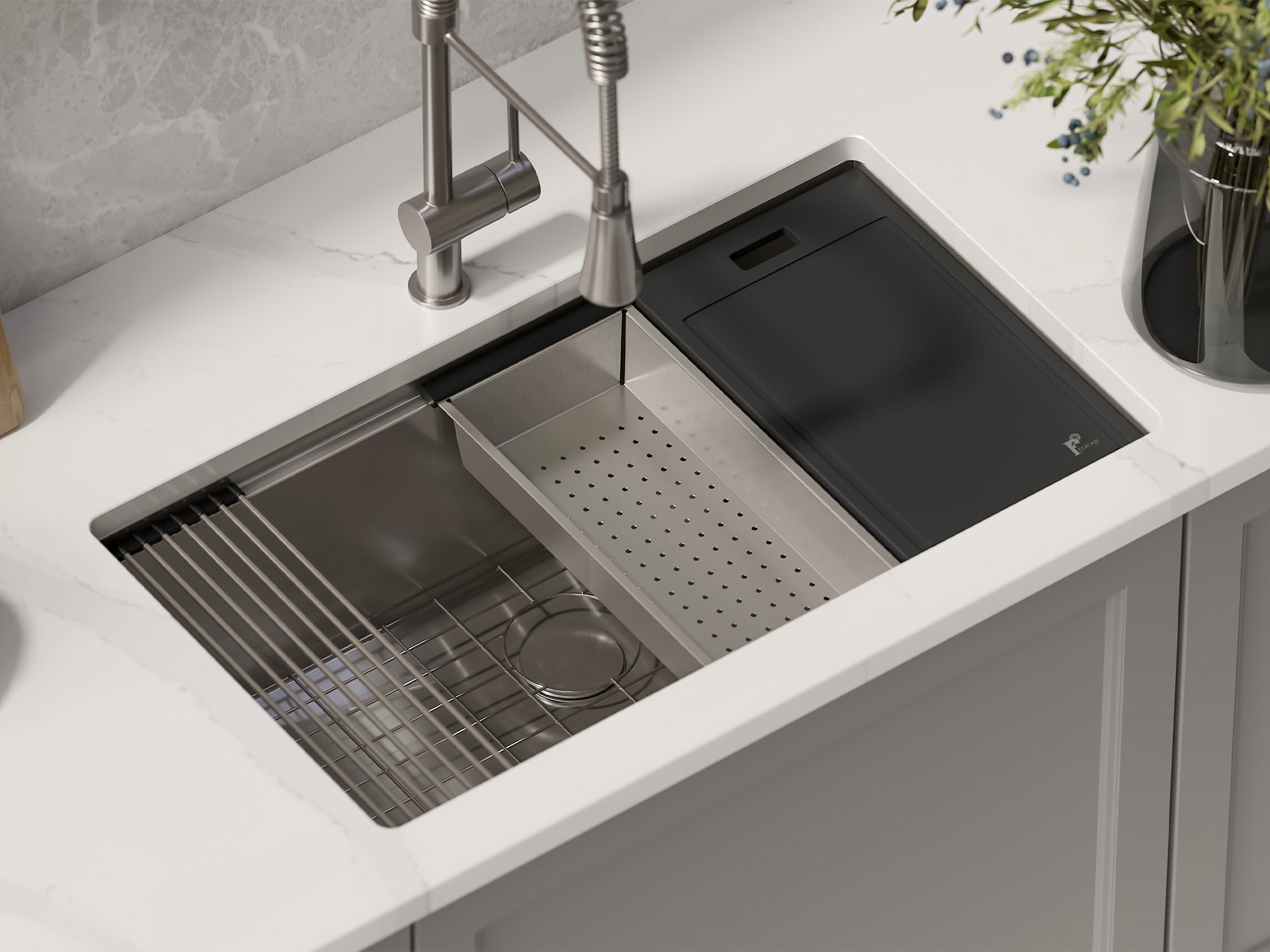
A workstation sink is a kitchen sink with an integrated ledge or track built into the upper portion of the bowl. That ledge supports accessories sized for the sink, such as a cutting board, colander, roll-up or folding drying rack, prep tray, or bottom grid.
The important distinction is that the accessories are not simply balancing across the countertop. They are designed to rest on a specific ledge so work can happen directly over the basin. Food scraps can fall into the sink, produce can drain without occupying counter space, and a drying rack can drip directly into the bowl.
A regular sink can use an aftermarket over-sink board or rack, and that can be a good low-cost way to test whether you like working over the basin. But a true workstation is designed around that workflow from the beginning, with the accessory track integrated into the sink geometry.
Workstation Sink Pros: Where the Design Really Helps
1. It can create usable prep space without adding more countertop
The strongest workstation advantage is simple: you can use the sink footprint as temporary workspace. In a small kitchen, condo, apartment, galley layout, or crowded cooking zone, that can matter more than adding another decorative sink feature.
A fitted cutting board can sit over part of the bowl while the remaining section stays open for rinsing or waste. This is especially useful when the counter beside the sink is narrow or when multiple ingredients are being prepared at the same time.
2. Prep, rinse, drain, and cleanup can stay in one zone
A workstation can reduce the number of times you move wet produce, dripping utensils, or food scraps across the counter. Rinse vegetables in a colander, move them to the board, and let scraps fall toward the bowl. That is the core workstation idea: not more gadgets, but a tighter workflow.
3. A large single bowl can become flexible instead of permanently divided
Many workstation sinks use one large basin. The accessories create temporary zones above the sink without dividing the bowl permanently. When the accessories come out, you still have an open basin for stock pots, sheet pans, roasting pans, and large cookware.
If you are deciding between bowl layouts, see our single-bowl vs. double-bowl kitchen sink guide.
4. Drying can happen above the drain instead of on the counter
A fitted folding rack can provide a place for glasses, produce, utensils, or small cookware to drain directly over the sink. That can help keep a stone or quartz countertop drier and reduce the amount of counter space occupied by a separate drying mat.
5. The accessory system can make a large sink more organized
A deep 28- or 33-inch single bowl offers excellent capacity, but without organization it can become one large catch-all. The ledge lets you introduce temporary structure when you need it and remove that structure when you want the entire bowl.
Workstation Sink Cons: What the Product Photos Usually Do Not Show
1. The accessories need somewhere to go
A cutting board, colander, folding rack, and bottom grid are useful only if they fit your routine. When they are not in use, they need storage. A wide fitted cutting board may not fit a normal drawer. A rack may stay on the sink full time until you need the entire bowl.
Before buying, decide where each accessory will live. This sounds minor, but accessory storage is one of the practical differences between a workstation that becomes part of the daily routine and one whose parts end up stacked awkwardly in a base cabinet.
2. The ledge adds another place to clean
The basin itself is not automatically harder to clean, but the workstation track can collect crumbs, food residue, water, and mineral deposits. Tight corners and zero-radius designs can also require more deliberate wiping than rounded corners.
If low-maintenance simplicity is your top priority, a conventional sink with softer corners and fewer fitted components may be easier to live with.
3. Accessories occupy part of the bowl when installed
That cutting board creates prep space by covering part of the sink. The drying rack creates a drying zone by covering part of the sink. If you frequently need the full bowl for oversized cookware, you may find yourself moving accessories more often than expected.
4. Replacement accessories can be model-specific
A workstation accessory is often designed for a particular ledge width and sink model. Do not assume a random cutting board or colander will fit later. Before buying, check what comes with the sink, whether replacements are available, and whether the manufacturer provides model-specific resources.
5. The full system can cost more than a simple sink
Workstation sinks are often positioned above basic sink models because you are paying for the integrated ledge, included accessories, and frequently more premium construction. That additional cost makes sense only if you will use the system.
If your kitchen already has a large island, abundant prep counter, and a dishwasher that handles most daily cleanup, a high-quality regular sink may deliver everything you actually need.
Are Workstation Sink Accessories Actually Worth It?
The answer depends on whether each accessory solves a task you already do. Do not buy based on accessory count alone. A package with six pieces is not automatically better than a package with three pieces you use every day.
| Accessory | Where It Helps | What to Check |
|---|---|---|
| Cutting board | Adds temporary prep surface | Storage, material care, replacement availability |
| Colander | Rinse and drain produce over bowl | Depth, fit, dishwasher/care instructions |
| Folding/drying rack | Drip-dry above drain | Weight rating, heat guidance, storage |
| Bottom grid | Keeps cookware off sink floor | Cleaning underneath, feet/bumpers |
| Strainer/drain cover | Finishes drain system | Disposal and plumbing compatibility |
The Pelican PL-WS3319, for example, includes a bottom grid, cutting board, colander, folding rack, basket strainer, and drain cover. That is a useful package because it covers prep, rinsing, drying, bowl protection, and drainage rather than padding the accessory count with decorative extras.
Who Should Buy a Workstation Sink?
A workstation is a particularly strong fit when several of these describe your kitchen:
- You cook and prep food most days.
- Counter space is limited or frequently crowded.
- You like one large single-bowl sink but still want flexible work zones.
- You rinse produce, chop, drain, or dry items around the sink.
- You regularly use large cookware and want the bowl fully open when accessories are removed.
- You want a coordinated accessory system rather than piecing together universal over-sink tools.
- You are already replacing the countertop and can plan the sink, faucet, cutout, and cabinet together.
In those kitchens, the workstation feature can be genuinely functional. The ledge is not just a styling detail; it changes how the sink footprint is used.
Who Probably Does Not Need a Workstation Sink?
A regular sink may be the smarter choice if most of these describe you:
- You rarely prepare food at the sink.
- You already have a large island or dedicated prep counter.
- You want the fewest possible parts to clean and store.
- You prefer a permanently open bowl with nothing sliding across it.
- You are doing a simple replacement and want the easiest path to match the existing cutout.
- You are outfitting a rental where accessories may be lost between occupants.
- Your budget is better spent on faucet quality, countertop work, plumbing, or cabinet improvements.
This is where many competitor guides become too promotional. A workstation is not an automatic upgrade for every kitchen. If you will not use the ledge, buy the better regular sink instead of paying for a feature you will ignore.
28-Inch vs. 33-Inch Workstation Sink: Which Size Makes Sense?
Workstation size changes both the bowl capacity and the usefulness of the accessory ledge. A wider sink gives you more room to leave an accessory in place while keeping part of the bowl open, but it also requires more cabinet and countertop space.
28-inch workstation sink
A 28-inch model can work well in a more compact kitchen where you still want the workstation concept without committing to a 33-inch sink. Pelican's PL-WS2819 measures 28" x 19" x 10" and uses 16-gauge 304 Series stainless steel.
33-inch workstation sink
A 33-inch model provides more working width and is a common choice for larger sink bases and busy kitchens. Pelican's PL-WS3319 measures 33" x 19" x 10", also using 16-gauge 304 Series stainless steel.
Do not choose by sink width alone. Verify the manufacturer's minimum cabinet requirement, exact outside dimensions, cutout/template, bowl depth, faucet position, countertop margins, and under-sink plumbing before ordering.
Installation and Countertop Planning Matter More With a Workstation
Most workstation frustration can be avoided before the countertop is cut. The sink, mounting style, faucet, cabinet, accessories, garbage disposal, and countertop opening should be treated as one system.
For an undermount workstation, the cutout remains visible and the reveal affects the finished look. The sink also needs correct support underneath. Large bowls, deep water capacity, heavy cookware, and a garbage disposal all add load, so the sink should never rely on sealant alone.
If you are still choosing the mounting style, read our undermount vs. drop-in kitchen sink comparison before countertop fabrication.
Plan the sink before the countertop template
When new quartz, granite, or solid-surface countertops are being fabricated, finalize the exact sink model first. The fabricator needs the correct template and desired reveal. A workstation's value drops quickly if the opening, faucet placement, or cabinet layout interferes with the accessories you bought it for.
What Is the Best Faucet for a Workstation Sink?
For many wide, deep workstation sinks, a pull-down kitchen faucet with appropriate spout reach is a strong match. The flexible spray head can reach across a large bowl and work around cutting boards, colanders, and racks.
But “high arc” does not automatically mean “good fit.” Measure:
- faucet height under cabinets, shelves, or windows;
- spout reach so water lands in the useful part of the bowl;
- handle clearance from backsplash or wall;
- spray-hose movement under the counter;
- clearance around accessories when they are on the ledge.
Use our kitchen faucet buying guide and pull-down vs. pull-out faucet comparison before pairing a faucet with a wide workstation sink.
Shopping for the sink and faucet together?
Compare the workstation sink dimensions first, then choose faucet height and reach around the actual bowl—not around a generic kitchen diagram.
Can You Use a Garbage Disposal With a Workstation Sink?
Yes, when the sink, drain opening, disposal, plumbing, and cabinet layout are compatible. The workstation ledge itself does not prevent a garbage disposal from being used.
The bigger issue is under-sink space and support. A deep 10-inch bowl already extends farther into the cabinet than a shallow sink. Add a disposal, P-trap, dishwasher connection, water filtration system, soap-dispenser bottle, and pull-down faucet hose, and the cabinet can become crowded quickly.
Before ordering, sketch the under-sink layout. Confirm that the disposal does not interfere with drawers, shelves, drain routing, or accessory storage.
Does 16 Gauge or 304 Stainless Steel Matter for a Workstation?
Yes—but these specifications should be evaluated with the entire sink, not used as standalone marketing shortcuts.
16-gauge stainless steel
Sixteen gauge is thicker than 18 gauge. In a large workstation sink, additional rigidity can be useful because the sink is wide, deep, and designed to support active prep accessories. That is one reason 16 gauge is a compelling specification in this category.
For a deeper comparison, see our guide to 16-gauge vs. 18-gauge stainless steel sinks.
304 Series stainless steel
Type 304 is widely used in quality kitchen sinks because it combines corrosion resistance, durability, formability, and cleanability. It is more accurate to call stainless steel corrosion-resistant than absolutely rust-proof; care, water chemistry, cleaners, and contamination still matter.
Both the Pelican PL-WS2819 and PL-WS3319 use 16-gauge 304 Series stainless steel. Learn more in our 304 stainless steel kitchen sink guide.
Sound treatment matters too
Gauge is not the only factor affecting sink noise. Sound-deadening pads and protective undercoating can reduce vibration and help control condensation underneath the bowl. Evaluate those construction details alongside gauge, finish, bowl geometry, and installation.
Are Workstation Sinks Hard to Clean?
They are not inherently difficult, but they have more surfaces and components to maintain than a plain bowl.
- Wipe the accessory ledge so food residue does not collect in the track.
- Clean underneath the bottom grid rather than leaving it permanently in place.
- Dry and store wood cutting boards according to their care instructions.
- Rinse colanders and racks after food prep.
- Avoid harsh cleaners or steel wool unless specifically approved by the manufacturer.
- Follow the sink manufacturer's care guide for the stainless finish.
Zero-radius corners and straight walls create a modern look and maximize usable interior space, but square corners generally need more deliberate wiping than broad rounded corners. Buyers who want the lowest-maintenance sink possible should weigh that trade-off before choosing a sharp-corner workstation design.
Are Workstation Sinks Good for Small Kitchens?
They can be excellent for small kitchens because the cutting board and drying rack temporarily recover space that would otherwise be lost to the sink opening. A workstation is especially useful when the sink sits in the primary prep zone and the counter on either side is limited.
But a workstation does not magically make an oversized sink fit a small cabinet. In a compact kitchen, a 28-inch model may make more sense than a 33-inch model. Always start with the cabinet and countertop dimensions, then choose the largest sink that fits without compromising structure, faucet placement, or storage.
Are Workstation Sinks Good for Rental Properties?
They can be, but rentals introduce a different priority: serviceability. A workstation may appeal in a premium rental or furnished unit where the kitchen experience matters. On the other hand, fitted accessories can be lost, damaged, or separated from the sink between tenants.
For high-turnover units, a simpler regular stainless sink may be easier to maintain and replace. For higher-end rentals, a workstation can make sense when the accessory package is documented and replacement parts are available.
Workstation Sink Buying Checklist
Before ordering, verify all of the following:
- Minimum cabinet size. The sink must fit inside the base cabinet with room for mounting and plumbing.
- Exact sink dimensions. Width, front-to-back depth, and bowl depth all matter.
- Mounting method. Confirm undermount, top-mount, dual-mount, or apron-front requirements.
- Countertop compatibility. Coordinate the cutout and finished edge before fabrication.
- Included accessories. Know exactly what comes with the sink.
- Replacement accessory availability. Model-specific pieces should be replaceable.
- Faucet height and reach. Make sure the water lands in the right part of the bowl.
- Garbage disposal clearance. Check space below the deep bowl.
- Drain position. Rear or offset drains change plumbing and storage.
- Gauge and steel grade. Evaluate them with sound treatment and overall construction.
- Corner radius. Tight corners look modern but may take more effort to clean.
- Care instructions and warranty. Read them before installation, not after a problem.
Best buying rule: Do not pay for a workstation because the accessory photo looks impressive. Buy one because you can name the exact tasks the ledge will make easier in your kitchen.
Workstation Sinks Available From Cavalieri Flooring
Cavalieri Flooring carries Pelican workstation sinks for buyers who want a large stainless bowl with an integrated prep system. Two useful sizes to compare are the 28-inch PL-WS2819 and 33-inch PL-WS3319.
Pelican Performance Series Workstation Options
- Pelican PL-WS2819 — 28" x 19" x 10", 16-gauge 304 Series stainless steel. A more compact workstation size for kitchens that do not need a 33-inch bowl.
- Pelican PL-WS3319 — 33" x 19" x 10", 16-gauge 304 Series stainless steel. Includes bottom grid, cutting board, colander, folding rack, basket strainer, and drain cover.
Both sizes should be matched to the actual base cabinet, countertop template, faucet, disposal, and plumbing plan before ordering.
Frequently Asked Questions
Are workstation sinks actually worth it?
They are worth it for people who regularly prep, rinse, drain, or dry items at the sink and will use the integrated ledge. They are less valuable when the kitchen already has abundant prep space or when the accessories are unlikely to be used.
What is the disadvantage of a workstation sink?
The biggest drawbacks are accessory storage, extra ledge cleaning, model-specific replacement parts, reduced open-bowl access while accessories are installed, and a potentially higher total cost than a simple sink.
Can you use a workstation sink without the accessories?
Yes. Most workstation sinks function as normal open bowls when the accessories are removed. That flexibility is one of their advantages.
Is a workstation sink better than a regular sink?
Not universally. A workstation is better when the ledge improves your prep and cleanup workflow. A regular sink can be better when simplicity, low maintenance, easy replacement, and unobstructed bowl access matter more.
What size workstation sink should I buy?
Start with the base cabinet and countertop, then compare the manufacturer's minimum cabinet requirement and exact sink dimensions. A 28-inch workstation can suit a more compact layout, while a 33-inch model provides more working width when the cabinet allows it.
Can a workstation sink have a garbage disposal?
Yes, when the sink, drain opening, disposal, and plumbing are compatible. Check clearance under deep bowls and make sure the disposal does not interfere with drain routing, drawers, filtration systems, or faucet hoses.
What faucet works best with a workstation sink?
A pull-down faucet with suitable height and spout reach is often a strong match for a wide workstation sink. Measure the actual bowl, countertop, backsplash, and overhead clearance rather than choosing the tallest faucet automatically.
Are workstation sinks harder to clean?
They have more components to maintain. The ledge, bottom grid, cutting board, colander, and rack need periodic cleaning, and tight corners can require more wiping. The basin itself is not inherently difficult when maintained according to the manufacturer's care instructions.
Is 16 gauge good for a workstation sink?
Yes. Sixteen-gauge stainless steel is a strong choice for large workstation sinks because it provides added rigidity. Gauge should still be evaluated with steel grade, sound treatment, bowl geometry, finish, and installation quality.
Need Help Choosing a Workstation Sink?
Tell us your cabinet size, countertop material, current cutout, preferred sink width, faucet plan, and whether you use a garbage disposal. We can help you narrow down workstation and stainless-steel sink options before you order.
Or call: (321) 424-0546
Related Sink Guides & Shopping Links
- Shop Workstation Sinks
- Pelican PL-WS3319 Workstation Sink
- Pelican PL-WS2819 Workstation Sink
- Shop Stainless Steel Kitchen Sinks
- Undermount vs. Drop-In Kitchen Sink
- 16 Gauge vs. 18 Gauge Stainless Steel Sinks
- 304 Stainless Steel Sinks: Are They Good?
- Single Bowl vs. Double Bowl Kitchen Sink
- How to Choose the Right Kitchen Faucet
- Pull-Down vs. Pull-Out Kitchen Faucets
Sources & References
Ready to Compare Workstation Sinks?
Start with your cabinet size and kitchen routine, then compare the sink dimensions, accessories, faucet fit, and installation requirements before ordering.