Stairs are the most technically demanding part of any flooring
installation — and the most visible. A staircase runs through the
vertical center of a home; it's the first thing guests see when
they walk in and the last thing they see as they leave. Getting it
wrong is immediately noticeable. Getting it right transforms the
entire interior.
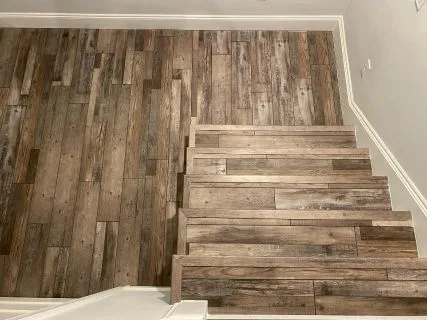
These projects showcase our team's approach to LVP stair tread
installations across multiple Central Florida homes. In each case,
the goal was the same: install LVP stair treads that look
precision-built, feel completely solid underfoot, match the
adjacent main floor planking, and remain silent and stable for
years of daily use.
Project Overview
This vinyl flooring staircase project was completed in Downtown Orlando,
Florida, for a general contractor. The design featured wood-look vinyl
flooring on the stair treads paired with clean white risers, creating a
modern contrast that matched the surrounding interior finishes.
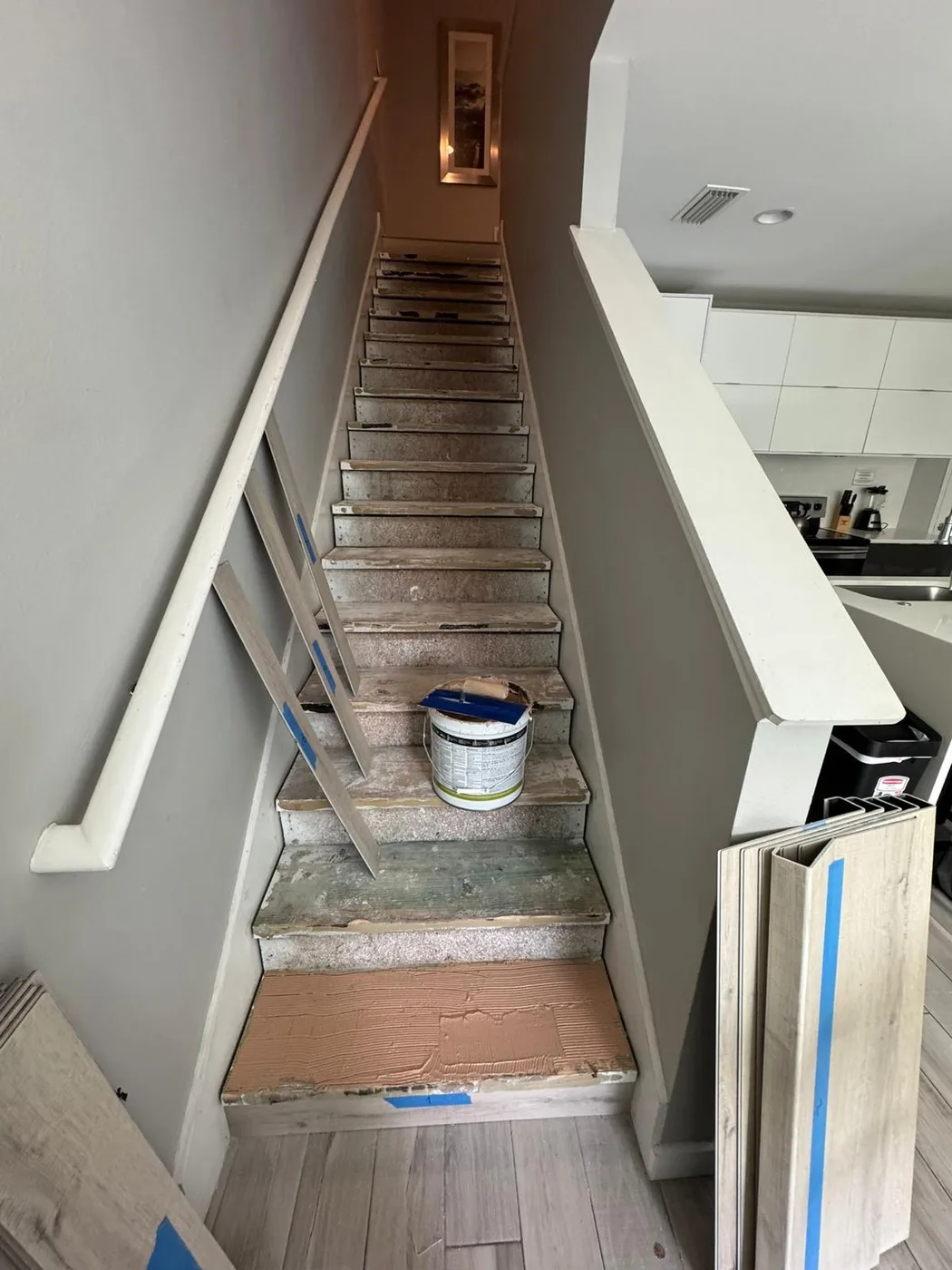
Before Stair Installation
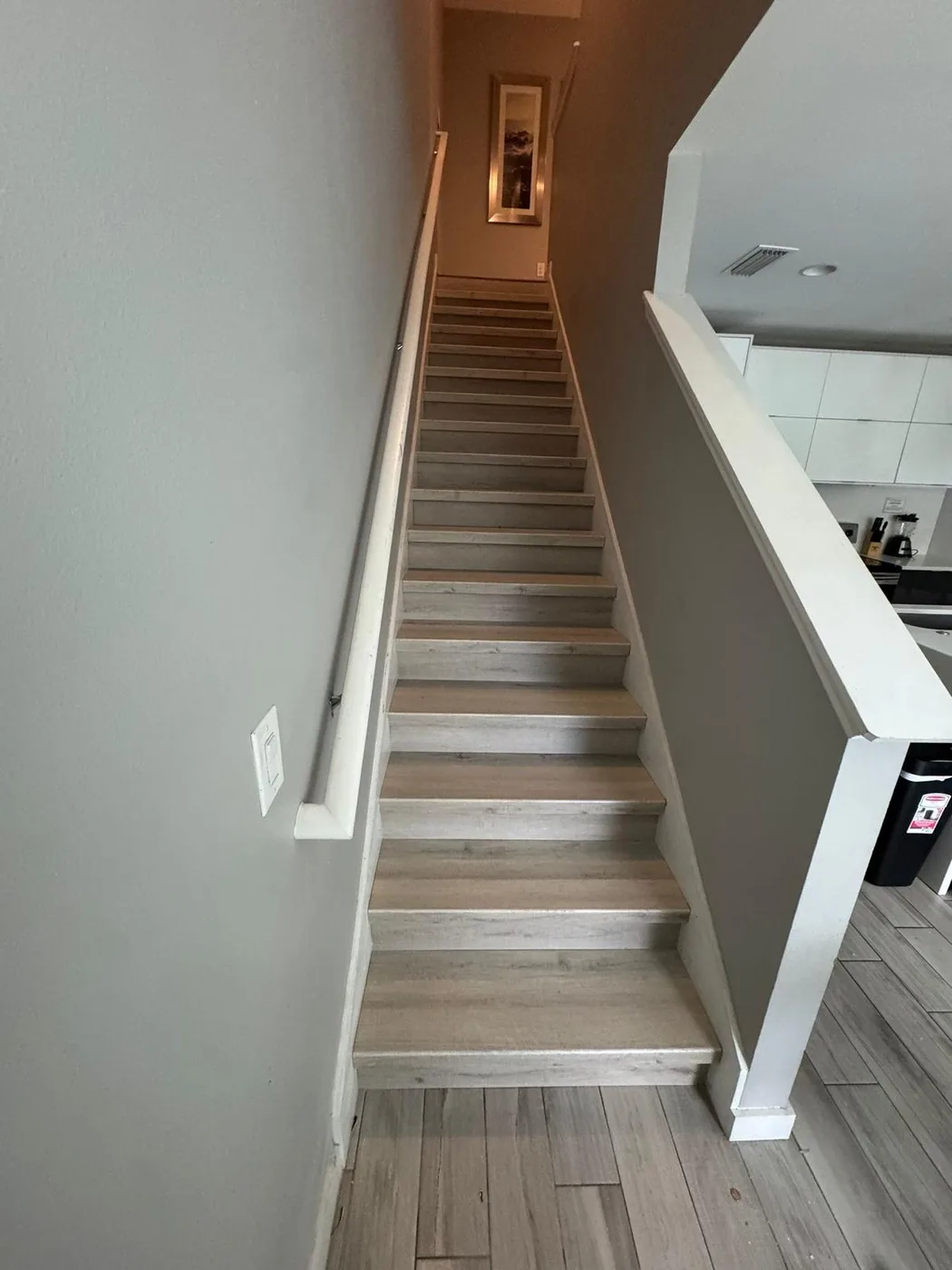
After Stair Installation
Project Challenges
The main challenge was achieving a highly detailed and precise finish
throughout the staircase. Every cut, edge, stair nose, and transition
had to align correctly because even a small imperfection would be
noticeable. The installation required careful measurements and
consistent placement across each step to create a clean, professional,
and uniform appearance.
Key challenges included:
Detailed vinyl flooring installation on each stair tread
Clean alignment between the flooring and white risers
Precise cuts around walls, trim, and stair edges
Consistent stair-nose placement on every step
Meeting the general contractor’s high-quality finish requirements
Maintaining a uniform appearance from the bottom to the top of the
staircase
Before Stair InstallationCompleted Staircase with White Risers
The Challenge: Why Stair Work Is Technically Demanding
Installing LVP on stairs is fundamentally different from installing it
on a flat floor. Every mistake is visible and structural. The specific
challenges include:
Precise dimensioning: Each tread must be cut to exact
width — not an inch wider or narrower than the stair surface. Uneven
cuts are immediately visible from across the room.
Adhesive bonding: Unlike a floor where planks support
each other, each stair tread must bond fully to its own substrate. Any
hollow spot or weak bond creates flex and eventual squeaking under
foot pressure.
Nosing installation: The stair nosing — the trim
piece at the leading edge of each tread — must be level, tightly
bonded, and perfectly aligned with the tread surface. A proud or
sunken nosing creates both a trip hazard and an eyesore.
Transition at top and bottom: Where the stairs meet
the landing or main floor, the transition must be seamless. This often
requires a specialized reducer or flush reducer piece that ties both
surfaces together cleanly.
Riser coordination: White-painted risers (the
vertical face of each step) must be painted cleanly around the tread
edges. Any paint bleed or ragged edge undermines the finished look.
Our Approach: Precision Glue-Down
We use a full-surface contact adhesive for all stair
tread installations — not just at the edges or in spots. The full
surface bond is what gives the tread that completely solid, no-flex feel
that floating or click-lock stair products cannot replicate.
Each tread is cut from the same LVP collection used on the main floor,
ensuring grain pattern, texture, and color are seamlessly consistent. We
pre-measure each individual stair tread for width before cutting —
staircases are rarely perfectly uniform in dimension from step to step,
and a good installer accounts for this.
The stair nosing is set in adhesive and then mechanically fastened where
the stair structure allows, giving it a fully permanent bond. We use a
nosing profile that sits flush with the tread surface for a clean visual
line and a safe step edge under foot.
The white-painted risers are masked and painted after the tread
installation is complete, preventing any paint contamination of the LVP
surface. The result is a crisp, clean contrast between the natural
wood-look tread and the bright white vertical riser — a classic,
design-forward look that works in contemporary, transitional, and
traditional home styles alike.
Results: Solid, Silent, and Show-Ready
These stair installations have held up through the highest-impact use in
the home. No flex, no squeak, no lifted nosing. Several of these
homeowners mentioned that friends and visiting family specifically
noticed the stairs as a design feature — not something that usually
happens when you redo the floors.
Full-surface adhesive bond — zero flex or movement on any tread
LVP matches main floor planking for a seamless whole-home look
Stair nosing flush-set and mechanically fastened for permanent hold
White-painted risers create bold contrast that elevates the aesthetic
Silent underfoot — no squeaking even under heavy or running foot
traffic
All stairs transitioned cleanly to upper-level and lower-level LVP
floors
LVP Stair Installation Services in Central Florida
Cavalieri Flooring installs LVP stair treads throughout the greater
Orlando and Central Florida area, typically as part of a full home
flooring installation. We also handle stair-only projects for homeowners
who have existing LVP and want to update their stairs to match.
Contact us for a free in-home estimate, or see our full LVP collection to find
your perfect stair tread plank.
Completed LVP installation across the residential staircase.
Frequently Asked Questions
LVP stair treads are precision-cut to width and glued down to each
stair surface using a strong contact adhesive. A stair nosing profile
is installed at the front edge of each tread for safety and a finished
look. Risers can be covered with matching LVP, painted wood, or left
natural depending on the design goal.
Stair nosing is a trim piece installed at the leading edge of each
tread. It protects the tread edge from wear, provides a clear visual
and tactile step boundary for safe footing, and completes the finished
look. Most building codes in Florida require stair nosing on
hard-surface stair installations. Cavalieri Flooring always includes
proper stair nosing as part of every stair project.
Yes — and matching the stair treads to the main floor LVP is the most
popular and visually seamless approach. We typically use the same
plank from the main floor installation, precision-cut to tread width.
The stair nosing is selected from the same collection or a
close-matching complement.
Modern LVP has a textured surface finish that provides good traction
underfoot. Properly installed stair nosing also improves safety by
clearly defining each step edge. For households with young children or
elderly residents, we can recommend specific LVP products with
enhanced texture ratings for stair applications.
A standard residential staircase (12–16 steps) typically takes 1 full
day for LVP tread installation, including adhesive cure time. If
risers need to be painted or refinished, that adds scheduling.
Combined with a main floor installation, stairs are usually completed
in the same visit.