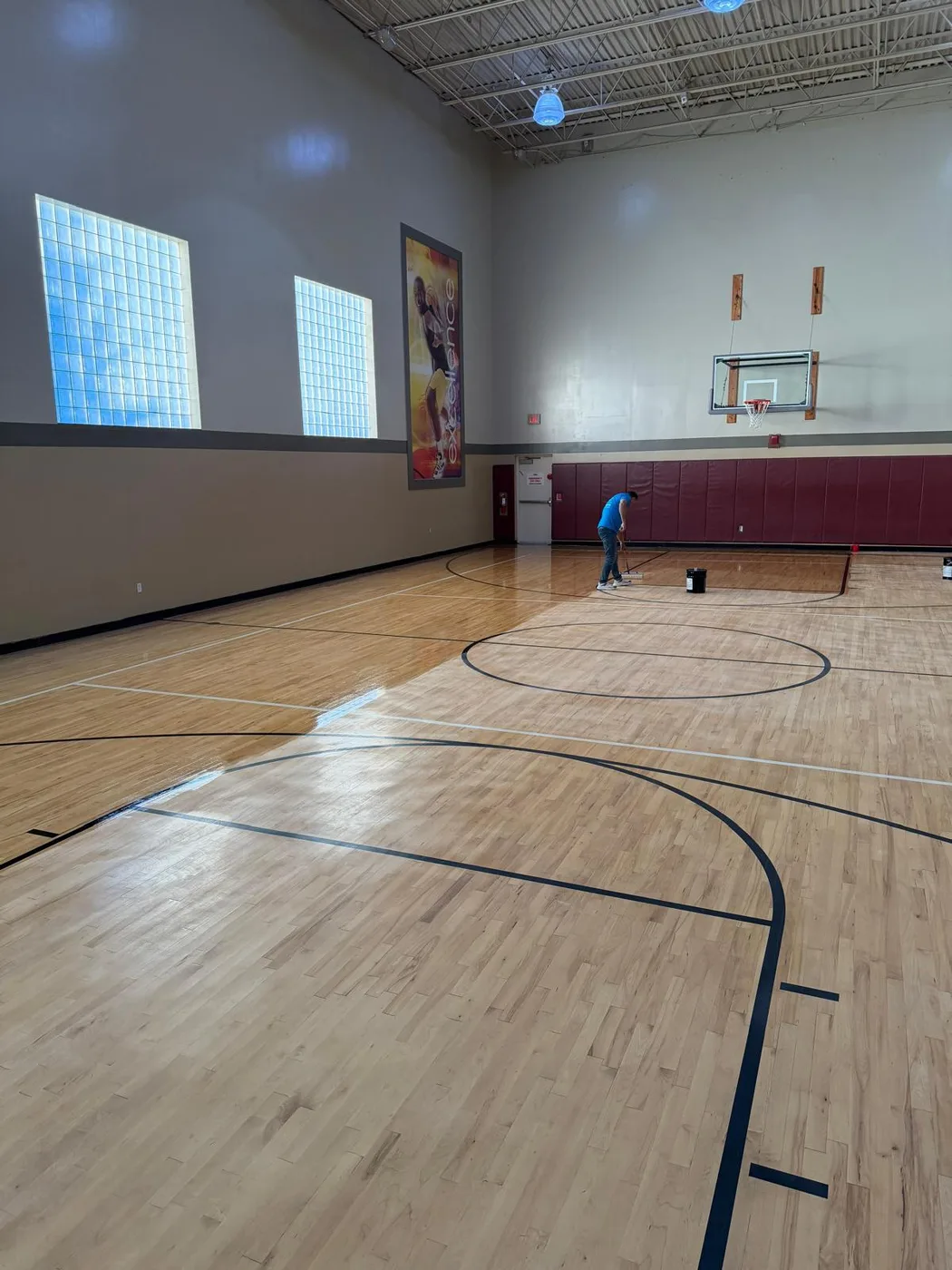
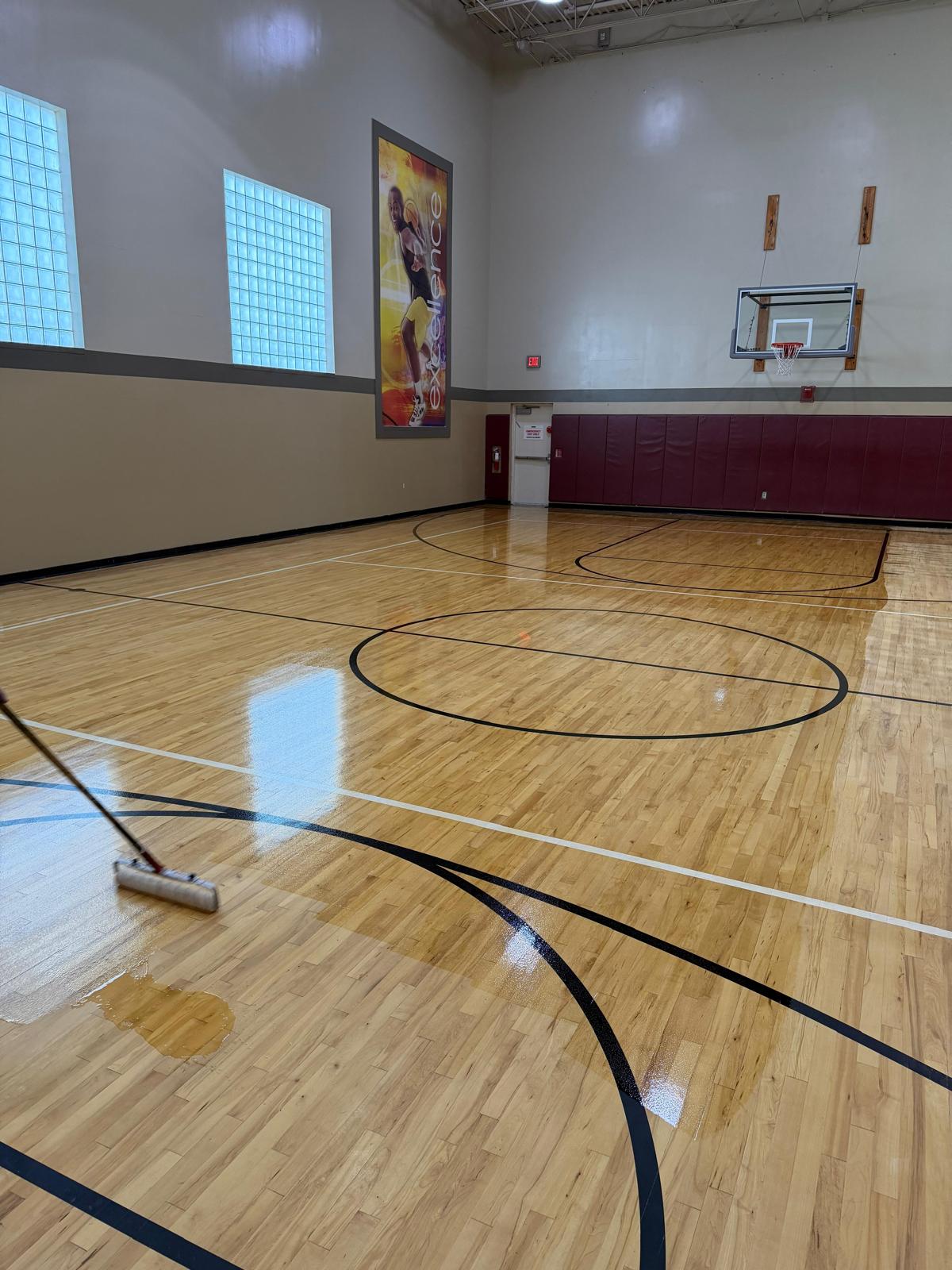
LA Fitness Athletic Hardwood Floor — Sand & Refinish
Full sand-down, board repairs, and commercial gym-grade finish on a heavily worn maple athletic hardwood floor at an LA Fitness location in Orlando, FL.
Athletic hardwood floors are among the most demanding surfaces in the commercial flooring world. They take direct impact from dropped weights, constant friction from rubber-soled athletic shoes, and repeated stress from jumping, pivoting, and lateral movement — all while being cleaned daily with commercial-strength disinfectants. After years of heavy gym use, the maple hardwood floor at this LA Fitness location in Orlando showed every bit of that wear: deep scuffs, surface oxidation, localized depressions from repeated equipment placement, and a finish that had worn through to bare wood in the highest-traffic zones.
LA Fitness's facilities team reached out to Cavalieri Flooring to assess whether the floor could be restored or whether full replacement was necessary. After a thorough inspection — checking for structural integrity, moisture levels, and board flatness — we determined that a full sand-and-refinish would restore the floor to like-new condition without the cost and disruption of a complete tearout and reinstallation.
The Challenge: Years of Gym Abuse
Restoring a commercial gym floor presents challenges that don't exist in residential refinishing work. The issues we identified during the initial inspection included:
Uneven wear pattern: Heavy traffic zones near the free-weight area had worn through the finish to bare wood, while perimeter zones still had most of their original finish — requiring more aggressive sanding in some areas to achieve a consistent depth across the full floor.
Embedded rubber and debris: Years of rubber mat use had left fused rubber particles in the wood grain in certain zones, requiring careful mechanical removal before sanding could begin.
Scuff accumulation: Black rubber marks from athletic shoes had penetrated through the finish layer into the top of the wood itself in high-pivot zones, requiring a deeper cut during sanding to fully eliminate.
Minor board movement: Several boards near the perimeter had developed slight cupping from moisture cycling through the HVAC system — these needed to be spot-flattened and secured before the main sanding pass.
Tight scheduling: As a commercial gym, the facility needed to minimize closure time. Every day the gym is closed is a day of lost membership revenue — so the project needed to be completed on a defined, compressed timeline.
Our Approach: Full Sand, Repair, and Commercial Gym Finish
We mobilized a dedicated crew with commercial drum sanders, edge sanders, and detail equipment to begin the project during a scheduled off-peak closure window. The process followed a systematic sequence designed to achieve a flat, consistent surface across the full gym floor before any finish was applied.
The first phase was mechanical preparation — securing any loose or cupped boards, removing embedded debris from the surface, and performing a full moisture reading to ensure the wood was within acceptable range before finishing. Elevated moisture is a common issue in Florida gyms where AC cycling and humidity swings can affect wood movement; we verified the floor was stable before proceeding.
The main sanding sequence used progressively finer grit — starting with a coarse cut to level the surface and remove deep damage, followed by medium and fine grits to open the grain cleanly and prepare for finish adhesion. Edge and detail sanding ensured the perimeter boards and corners matched the field flatness without leaving visible transition lines.
After sanding and thorough dust removal, we applied commercial-grade athletic floor polyurethane in multiple coats with light abrasion between each coat to ensure adhesion and build a full protective film thickness. The finish selected provides high scratch resistance, UV stability, and the specific sheen level appropriate for a gym environment — durable enough to resist equipment and shoe traffic, but without the high-gloss reflection that would create glare issues for athletes.
Results: Like New — On Time and On Budget
The completed floor transformed the gym's aesthetic and functionality. The uniform, freshly finished maple surface reflected the gym's lighting evenly across the full floor, creating the bright, energized atmosphere that gym-goers expect. Staff reported that the floor was notably easier to clean post-refinish — the fresh finish surface repels surface contamination rather than absorbing it as the old worn finish did.
The project was completed within the scheduled closure window with no schedule overruns, allowing the gym to reopen on time. LA Fitness facilities management confirmed the result met their brand standards for floor appearance.
Full surface uniformity achieved — no visible worn zones or finish variation
All scuffs, oxidation, and rubber embedding eliminated
Commercial gym-grade finish applied in multiple protective coats
Project completed on schedule, minimizing gym closure time
Floor ready for immediate heavy use upon reopening
Why Sand and Refinish Instead of Replace?
One of the most common questions we hear from commercial facility managers is whether to refinish or replace a worn hardwood floor. In most cases, solid hardwood floors can be sanded and refinished multiple times over their lifetime — quality maple athletic floors are typically 3/4 inch thick and can sustain 5 to 8 full sanding cycles before replacement becomes necessary. Refinishing costs a fraction of full replacement and, when done correctly, returns the floor to essentially like-new condition.
For LA Fitness, the choice to refinish rather than replace saved the facility tens of thousands of dollars compared to a full tearout and reinstall, while delivering a result that is visually indistinguishable from a new floor installation. It also eliminated the added closure time that a full replacement would have required — a critical factor for a commercial gym where revenue is directly tied to days of operation.
Refinished hardwood athletic flooring at LA Fitness.
Frequently Asked Questions
Most commercial gym hardwood floors need a full sand and refinish every 5 to 10 years depending on usage intensity. High-traffic fitness centers with daily use may need a screen-and-recoat every 2 to 3 years and a full sand every 7 to 10 years. Cavalieri Flooring inspects each floor individually — we never recommend more work than the floor actually needs.
Athletic hardwood floors require a commercial-grade polyurethane or sport finish rated for high foot traffic, rubber-soled shoes, and equipment use. These finishes are significantly more durable than residential finishes and are typically applied in multiple coats for maximum hardness and abrasion resistance. We use finishes rated for commercial gym environments.
Yes — during a full sand-and-refinish job, our team identifies boards that are cracked, cupped, or structurally compromised and replaces them before sanding. This is one of the key advantages of a full sand vs. a screen-and-recoat: damaged boards are addressed at the same time, ensuring a flat, uniform surface across the entire floor.
A typical commercial gym hardwood refinish requires 3 to 5 days of closure: 1 to 2 days for sanding and board repairs, 1 day for stain (if applicable), and 2 to 3 days for finish coats to cure fully. We plan around the facility's schedule to minimize revenue impact and can often schedule work over a long weekend or holiday period.
Yes. We provide athletic hardwood sand-and-refinish services for gyms, fitness centers, school gymnasiums, multi-purpose courts, and recreational facilities throughout Orlando and Central Florida. Contact us for a free on-site assessment and estimate.